Atlassian Statuspage is the status page many companies know by name, and its free plan is a fair place to start: 100 subscribers, 25 components and two team members. People look elsewhere when the page has to grow, because each step up is priced by subscribers and the steps are steep, and because Statuspage’s pricing page lists no uptime monitoring, so the tool that knows your site is down is a second product.
We make Monity, one of the tools below, so read our take with that in mind. Every price and limit here comes from each vendor’s own pricing page, checked on 18 November 2026.
Why people look for a Statuspage alternative
From what Atlassian’s own pricing page lists, the reasons are usually one of these:
- The price of subscribers. Hobby is $29/month for 250 subscribers. Startup is $99/month for 1,000, Business $399/month for 5,000 and Enterprise $1,499/month for 25,000.
- Features held back for higher plans. A custom domain starts on Hobby. Webhook notifications and custom CSS start on Startup.
- Monitoring is separate. The pricing page lists subscribers, components, team members and metrics. It lists no uptime checks, so something else has to tell the page that a service is down.
- More than one page. Public, private and audience-specific pages are separate plans.
The short answer
- You want the status page and the uptime monitoring in one tool, with no price for the page: Monity, which includes up to 20 status pages on every plan.
- You want a free page with its own monitors and plenty of subscribers: Instatus, whose free Starter plan has 15 monitors and 200 subscribers.
- You want the status page inside an on-call and incident platform: Better Stack.
- You already monitor with UptimeRobot: its status pages come with the plan, and Solo puts 3 on your own domain.
- Your engineers already run Checkly: its status pages are a small separate plan.
- You need private pages, single sign-on or webhooks for subscribers: stay on Statuspage.
Statuspage alternatives compared
| Tool | Free plan | Paid plans from | Subscribers | Monitoring included |
|---|---|---|---|---|
| Statuspage (for reference) | 100 subscribers, 25 components | Hobby: $29/month | 250 on Hobby; 1,000 on Startup ($99/month) | Not on the pricing page |
| Monity (ours) | Status pages on the free plan, with 3 monitors | Personal 1k: $10/mo billed annually ($12 monthly) | Up to 20,000 a page, on every plan | Yes: the page is built from its uptime monitors |
| Instatus | 15 monitors, 200 subscribers | Pro (price not shown when we checked) | 5,000 on Pro | Yes: 15 monitors on Starter, 50 on Pro |
| Better Stack | 10 monitors and heartbeats, 1 status page (personal projects) | Responder: $29 per license per month billed annually ($34 monthly) | 1,000 included; $40 per month for each additional 1,000 | Yes: 10 monitors included |
| UptimeRobot | 50 monitors, 1 basic status page | Solo: €9/month billed annually (€10 monthly) | From Team | Yes: 50 monitors on the free plan |
| Checkly | 20 services, 250 subscribers | Starter: $9 per month billed annually | 500 on Starter | Sold as a separate plan |
The alternatives, one by one
Monity (ours)
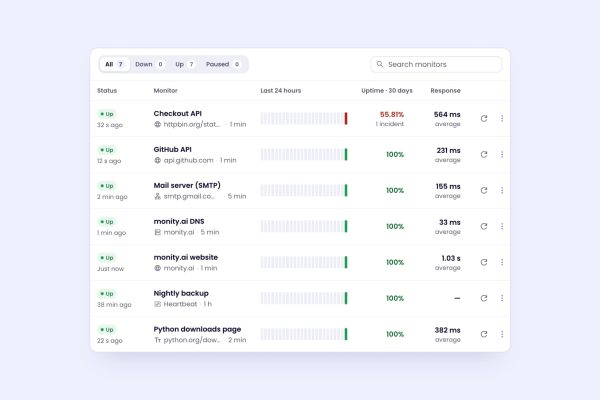
A Monity status page is built from Monity’s own uptime monitors. You choose which monitors a page shows, and from then on it keeps itself up to date: each monitor has its status, a bar for each of the last 90 days and its uptime, and a monitor that goes down shows on the page without anyone touching it.
What’s different from Statuspage:
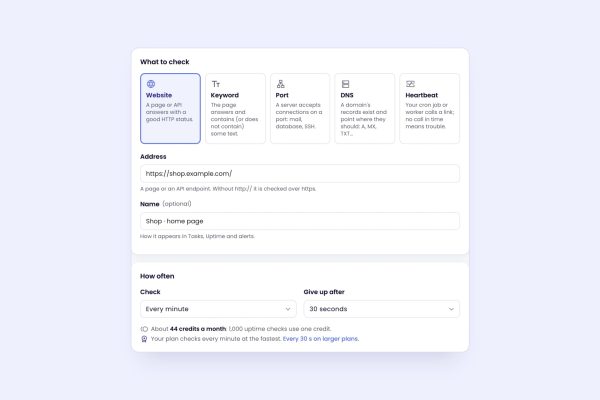
- The monitoring comes with it. Website, keyword, port, DNS and heartbeat monitors feed the page. There is no second product to connect.
- No price for the page. Status pages are on every plan, the free one included, up to 20 per account: one per product, or one per client.
- Subscribers are not what you pay for. A page can have up to 20,000 email subscribers on every plan. Each one confirms by email first.
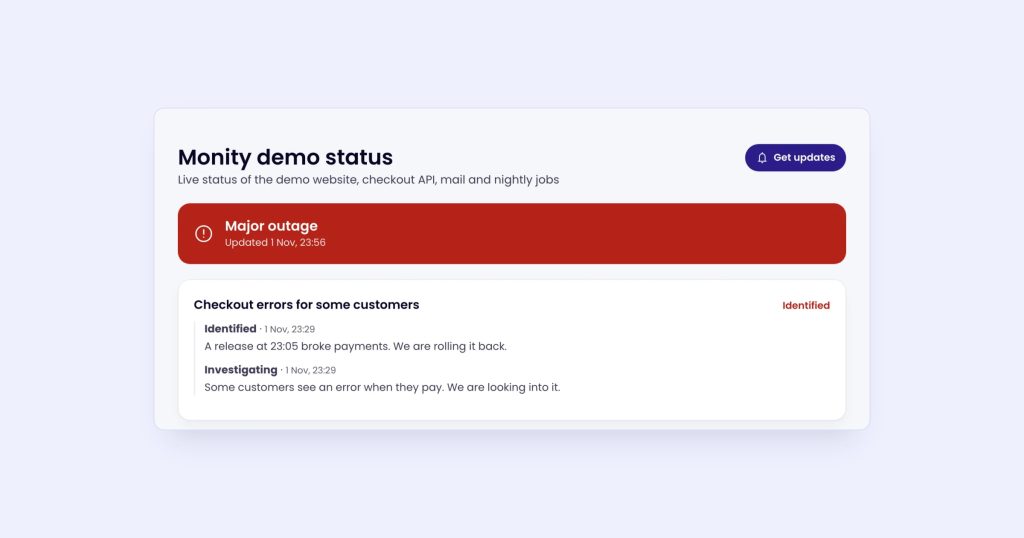
- Incident and maintenance posts. A post has an impact and a status (investigating, identified, monitoring, resolved), and resolved posts stay on the page for 14 days. The status pages docs show each part.
For the two side by side, see Monity vs Statuspage.
How it’s priced: the free plan has 3 tasks, so a free status page shows up to 3 monitors, checked every 5 minutes. Personal 1k is $10/mo billed annually ($12 monthly).
Pick something else when: you need custom CSS, a private page or single sign-on. A Monity page takes your logo and an accent colour, tells subscribers by email only, and always ends with a small “Monitored by Monity” line.
Want to see it on your own site first?
Send us the sites, pages and journeys you check by hand. We set up the monitors, confirm they read the right thing and email you the first result, usually within a business day. Free, no account, no card.
Instatus
Instatus is a status page with monitoring and on-call built in. Its free Starter plan is generous for a small product: 15 monitors checked every 2 min, a public status page and 200 subscribers, with alerts by email. Pro raises that to 50 monitors checked every 30 sec, 5,000 subscribers, 5 team members and a custom domain. Business goes to 1,000 monitors and 25,000 subscribers, with every type of status page.
The paid prices did not show on the pricing page when we checked, so look there before you decide.
Pick it when: you want a free page with its own monitors and more subscribers than Statuspage’s free plan allows.
Better Stack
Better Stack is an incident platform: uptime monitoring, on-call schedules, phone call alerts and logs, with status pages as one part. The free plan, for personal projects, has 10 monitors and heartbeats and 1 status page. A Responder license is $29 per license per month billed annually ($34 monthly) and includes 1 status page with 1,000 subscribers.
More pages and fewer limits cost extra: an additional public status page is $12 per month billed annually ($15 monthly), each additional 1,000 subscribers is $40 per month, and removing the “Powered by Better Stack” footer is $208 per page per month billed annually ($250 monthly).
Pick it when: the status page should sit next to your on-call rota and incident timeline.
UptimeRobot
UptimeRobot is an uptime monitor first, and its status pages come with the plan. The free plan has 50 monitors checked every 5 min and 1 basic status page. Solo, at €9/month billed annually (€10 monthly) for 10 monitors, gives 3 status pages on your own domain. Subscribers and a white-label page start on Team, which has 100 status pages.
Pick it when: you already monitor with UptimeRobot and a simple public page is enough. Our Monity vs UptimeRobot page has the two side by side.
Checkly
Checkly is monitoring as code for engineering teams, and it sells status pages as their own small plan. The free tier has 20 services and 250 subscribers. Starter is $9 per month billed annually for 25 services and 500 subscribers, and Team is $30 per month billed annually for 50 services and 1000 subscribers.
Pick it when: your checks already live in Checkly and you want the page fed by them.
When to stay on Statuspage
Statuspage does things the tools above mostly do not. Stay when you need any of these:
- A private or audience-specific page, for staff or for named customers.
- Single sign-on for team members, which starts on Startup with Atlassian Guard.
- Webhook notifications for subscribers, also from Startup.
- Your own CSS, HTML and JavaScript on the page, from Business.
- The rest of Atlassian. If incidents already run through Atlassian’s tools, the page fits in.
How to switch without losing your subscribers
- List the components on your Statuspage and what each one stands for: the website, the API, the app.
- Set up a monitor for each in the new tool, and let them run for a few days so the new page has history.
- Build the page and check it shows what the old one did.
- Ask your subscribers to subscribe to the new page. Most tools make each person confirm by email, so you cannot move the list for them.
- Keep the old page up, with a link to the new one, until your customers have moved.
Our guide on how to create a status page covers what to put on the page and how to write an incident update.
Try Monity on the sites you look after
Start on the free plan in a few minutes, or let us set it up and send you the first result. Slack, Teams, Google Sheets and every other alert channel are included either way.