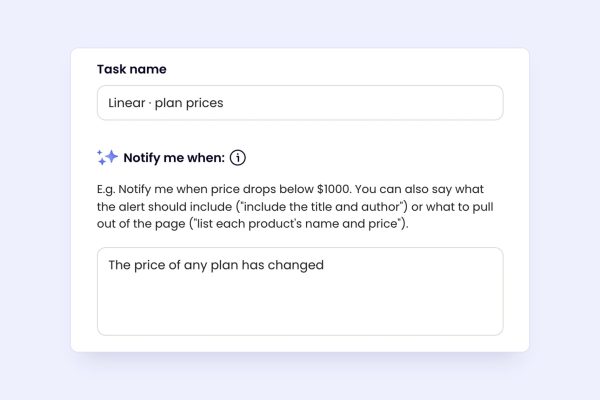
The right Apify alternative depends on what you used Apify for: ScrapingBee, Firecrawl or Bright Data for a scraping API you call from code; Browse AI or Octoparse for point-and-click robots; Crawlee to keep Apify’s own crawler without the platform. If you want a table from a few sites kept up to date, with alerts when rows change, Monity (monity.ai) Datasets does that, but it is in Beta. We make Monity, so weigh what we say about it with that in mind. Every price below was read on the vendor’s own pricing page on 23 November 2026.
What does Apify cost, and why do people look elsewhere?
Apify’s plans are prepaid usage (Apify pricing): Free ($0, with $5 a month to spend), Starter ($19 a month), Scale ($199) and Business ($999). Each paid plan gives you its price to spend in the Apify Store or on your own Actors, and yearly billing takes 10% off. Compute is billed per compute unit, one GB of RAM for one hour: $0.20 on Free and Starter, $0.16 on Scale and $0.13 on Business. Unused credits “expire at the end of the billing cycle”. Many Store Actors also charge per event; the page’s example is an Instagram scraper at $2.30 per 1,000 results.
That model suits teams that run a lot of their own code. People usually leave for one of two reasons: a bill that’s hard to forecast once compute, proxies and per-result fees add up, or more platform than they need for a few pages collected again and again.
Which Apify alternative fits which job?
| Tool | The job it fits | Free | Paid from | API for on-demand scraping |
|---|---|---|---|---|
| ScrapingBee | A scraping API that renders JavaScript and rotates proxies | 1,000 trial credits | $19 a month (75,000 credits) | Yes |
| Firecrawl | Pages as Markdown or JSON for AI apps | 1,000 credits a month | $19 a month, $16 billed yearly (5,000 credits) | Yes |
| Bright Data Web Scraper API | Records at volume, paid only for successful ones | 5,000 records a month | $1.50 per 1,000 records, pay as you go | Yes |
| Browse AI | No-code robots, monitoring and spreadsheets | 50 credits a month, 2 websites | $48 a month, or $19 billed yearly (Personal) | Yes |
| Octoparse | A visual scraper built around a desktop app | 10 saved tasks; 2,000 rows a month from templates, AI and API runs | $19 a month (Basic, monthly only) | Limited on Free and Basic, unlimited from Standard |
| Crawlee | Apify’s open-source crawling library, on your own servers | Free | Your hosting and proxies | You build it |
| Monity Datasets (Beta) | Tables from up to 1,000 pages kept up to date, with alerts on changed rows | 100 credits a month on the free plan | $12 a month, or $10 billed yearly (1,000 credits) | No |
Which alternative should developers use?
ScrapingBee is one HTTP endpoint that renders the page and rotates proxies. Watch the multipliers: requests “start at 1 credit each”, a request with JavaScript rendering costs 5 credits, and premium proxies cost 10 or 25. The Hobby plan’s 75,000 credits are therefore 15,000 rendered pages, and credits don’t roll over to the next month.
Firecrawl fits AI and RAG pipelines. A basic scrape costs 1 credit, and the JSON format adds 4 credits a page. It also has a Monitor feature, billed at 7 credits a page per check. The free plan’s 1,000 credits are enough to test it on your own sites.
Bright Data’s Web Scraper API charges per record, one extracted item such as one profile, with “proxies, unblocking, parsing included”. Its Scale plan is $499 a month for 384,000 records, then $1.30 per 1,000.
Which alternative works without code?
Browse AI trains a robot as you click on the page. Its site lists website monitoring with change detection, Google Sheets and Airtable, Zapier, webhooks and a REST API. The yearly discount is large (Personal is $48 a month, or $19 a month billed yearly), plans cap the number of websites (2 on Free, 10 on Personal), and sites it marks Premium, the ones that need residential proxies and captcha solving, cost at least 2 to 10 credits a run.
Octoparse builds workflows in a desktop app. Its free plan runs tasks on your own computer; scheduled cloud runs and unlimited API access start at Standard, $83 a month or $69 a month billed yearly. A Black Friday discount of up to 35% on yearly plans was running when we read the page.
Can you keep Apify’s code and leave the platform?
If your scrapers are built on Crawlee, yes. It is Apify’s web scraping library for JavaScript and Python, “forever free and open-source”. You run it on your own servers, so you swap Apify’s bill for hosting, proxies and upkeep.
Where does Monity Datasets fit, and where doesn’t it?
Datasets is the newest part of Monity and it is in Beta. The app says so itself: “Datasets are new and may not be perfect yet.” Try it on your own pages before you depend on it.
You click one item in a list and Monity finds the rest, then add steps such as Next page or opening each item’s own page. A run starts from up to 1,000 addresses, a CSV or a sitemap, within limits you set of up to 100 list pages an input, 10,000 rows and 60 minutes. It collects again on a schedule, from every hour to once a month, and compares each run with the last, row by row: new, changed, removed and returning.
Where it is strong:
- Changed rows go straight to Slack, Microsoft Teams, Discord, Telegram, email, Google Sheets (a sheet row for each changed row) or a webhook, on every plan.
- Claude Code, Codex and other MCP clients can read the rows and the changes with an API key.
- It uses the same credits as Monity’s page monitors, uptime monitors and browser tests: 1 per page a run opens, 5 more per page an AI step reads, and 2 a minute while a run uses a saved login.
Where it falls short:
- It is in Beta, and we haven’t yet proved it at the volumes the tools above handle.
- There is no scraping API for on-demand runs. A dataset runs on its schedule or when you click Run now in the app.
- Monity has no proxy of its own for Datasets. A blocked page is marked Blocked, and you can read it through your own proxy.
- There is no marketplace of ready-made scrapers for sites such as Google Maps or Instagram.
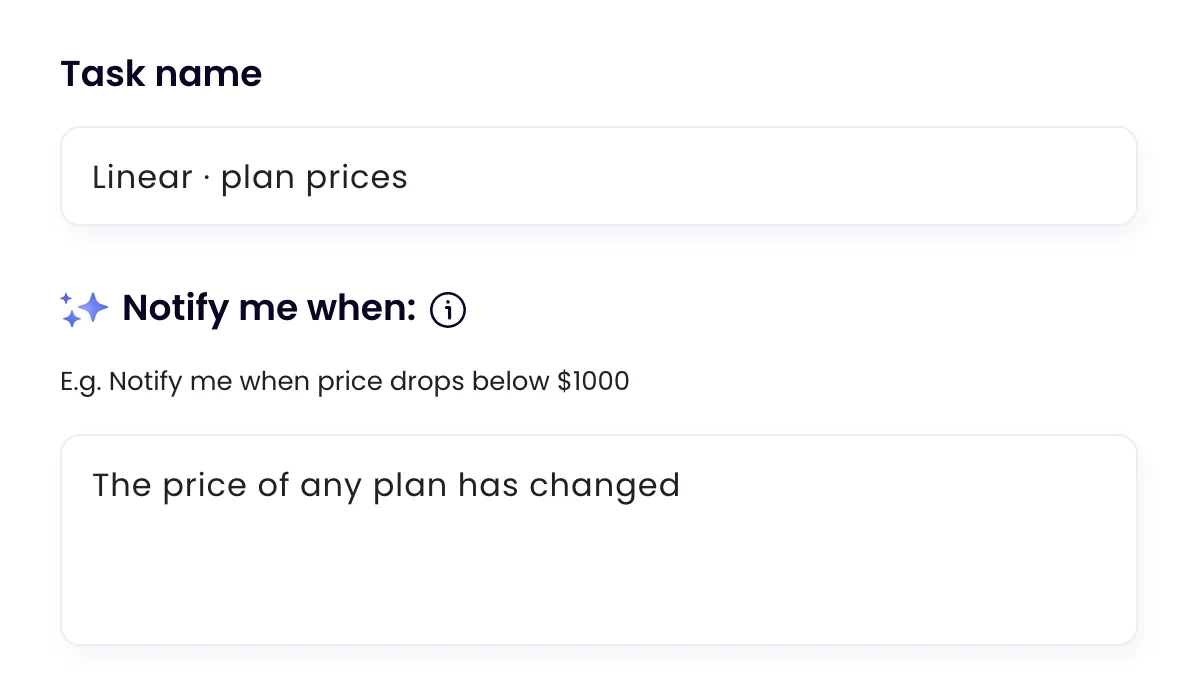
If you only need a handful of pages watched, such as competitors’ pricing pages, a page monitor like this may be all you need. Our guide to competitor price monitoring shows how.
When should you stay on Apify?
- You rely on Store Actors for sites such as Google Maps or Instagram and don’t want to build and maintain your own.
- You start custom Actors on demand from your own code through Apify’s API.
- Your pipelines work and the bill fits your plan.