If the Wayback Machine has no copy of the page you need, try Archive.today, which keeps its own snapshots, then a library or national archive such as the Library of Congress or Arquivo.pt. To keep a copy yourself from now on, save it with Perma.cc, ArchiveWeb.page or ArchiveBox, or have it captured on a schedule with Stillio or Monity (monity.ai), which also alerts you when the page changes.
Which Wayback Machine alternative to use
Each tool as its own pages describe it, read on 23 November 2026:
| What you need | Tool | What you get | Its limit |
|---|---|---|---|
| An old copy | Archive.today | Snapshots you search by address or site; a new snapshot of a live page with a public link | Scripts are removed, so interactive parts of the page don’t work |
| An old copy | Library of Congress Web Archives | Collections you can browse, or search by address and capture date | Only what the Library collected and can show online |
| An old copy | Arquivo.pt | A search of pages published since 1996 | Mainly sites of the Portuguese community, with some international ones |
| A public copy now | Save Page Now (the Wayback Machine’s own) | A capture of a page in the Wayback Machine | One address per submission |
| A copy to cite | Perma.cc | A permanent link to an archived copy, kept by a network of libraries | Built for citing a page, not for finding old ones |
| A copy on your computer | ArchiveWeb.page | A recording of what you browse, replayed locally and exported as WACZ or WARC | You capture each page by hand |
| Your own archive server | ArchiveBox | A self-hosted app that saves pages in several formats | You run and maintain it |
| Screenshots on a schedule | Stillio | Screenshots every hour, day, week or month, archived in the cloud | A paid service, with a free trial |
| Changes on a schedule | Monity | A screenshot of every check, and an alert when the page changes in the way you describe | Its history starts at your first check |
The first three look backwards: they can only show what someone captured. The others look forwards: they keep the copies you ask for, from the day you ask.
Find a copy of a page that already changed
Start with the exact address, including the path. For an old pricing page, searching only the home page can show months of captures without the price table you need. If the exact address finds nothing, try the old hostname, or the address with and without www. Open the capture closest to the date you want, and check its timestamp and its contents before you cite it: some captures miss images or have broken links. The Internet Archive’s help on using the Wayback Machine explains how to read them.
Then try Archive.today: search the same address or the whole site. Its snapshots are separate from the Wayback Machine’s, so a page one missed may be in the other.
For a page that fits a collection, try the Library of Congress Web Archives, which hold themed collections such as the United States Elections Web Archive. For a Portuguese site, or an international one Arquivo.pt collected, search Arquivo.pt by address or by words on the page.
Save a copy you can cite or keep
For a public link, use Save Page Now or Archive.today. Save the specific pages you care about: Save Page Now takes one address per submission, as the Internet Archive’s capture instructions say.
If you’re citing a page in a paper, a court filing or an article, Perma.cc is built for that: Harvard’s Library Innovation Lab describes it as a tool that prevents link rot by keeping an archived copy through its network of libraries.
For a copy you control, record the page with ArchiveWeb.page: open a recording, load the page, click through what you need, replay it to check, and export the session as a WACZ or WARC file. To archive many pages on your own server, use ArchiveBox, which you install and look after yourself.
Keep a record of a page from today onward
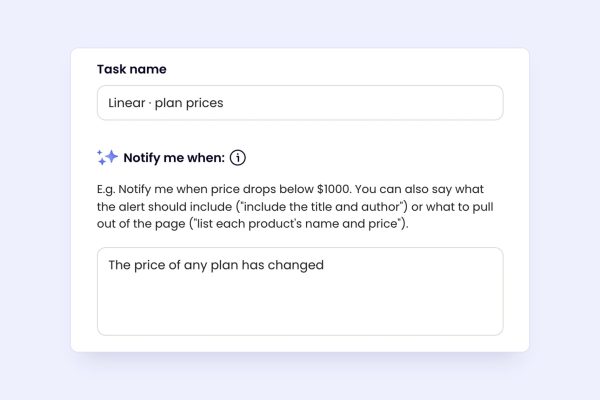
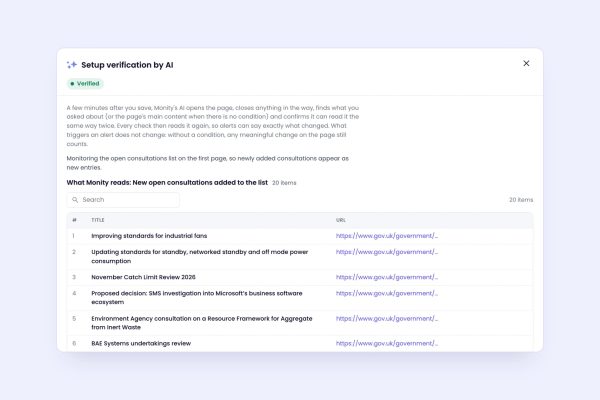
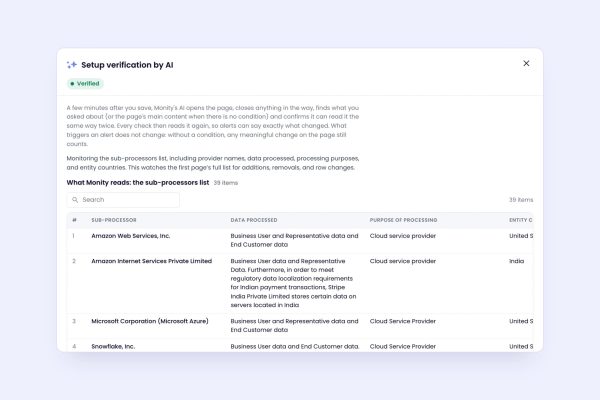
If what you need is to know when a page changes, an archive you visit later is the slow way. Stillio takes screenshots on a schedule and keeps them. Monity checks the page on a schedule, keeps a screenshot of every check, and alerts you when it changes in the way you described.
Say you need to know when the plan names or prices change on a supplier’s pricing page. In Monity, paste the pricing page’s address into Ask Monity and write “Tell me if a plan name or monthly price changes.” The first check records the starting point (see the quick start). To watch how the page looks rather than its text, choose Visual with a full-page or selected-area capture (visual monitoring).
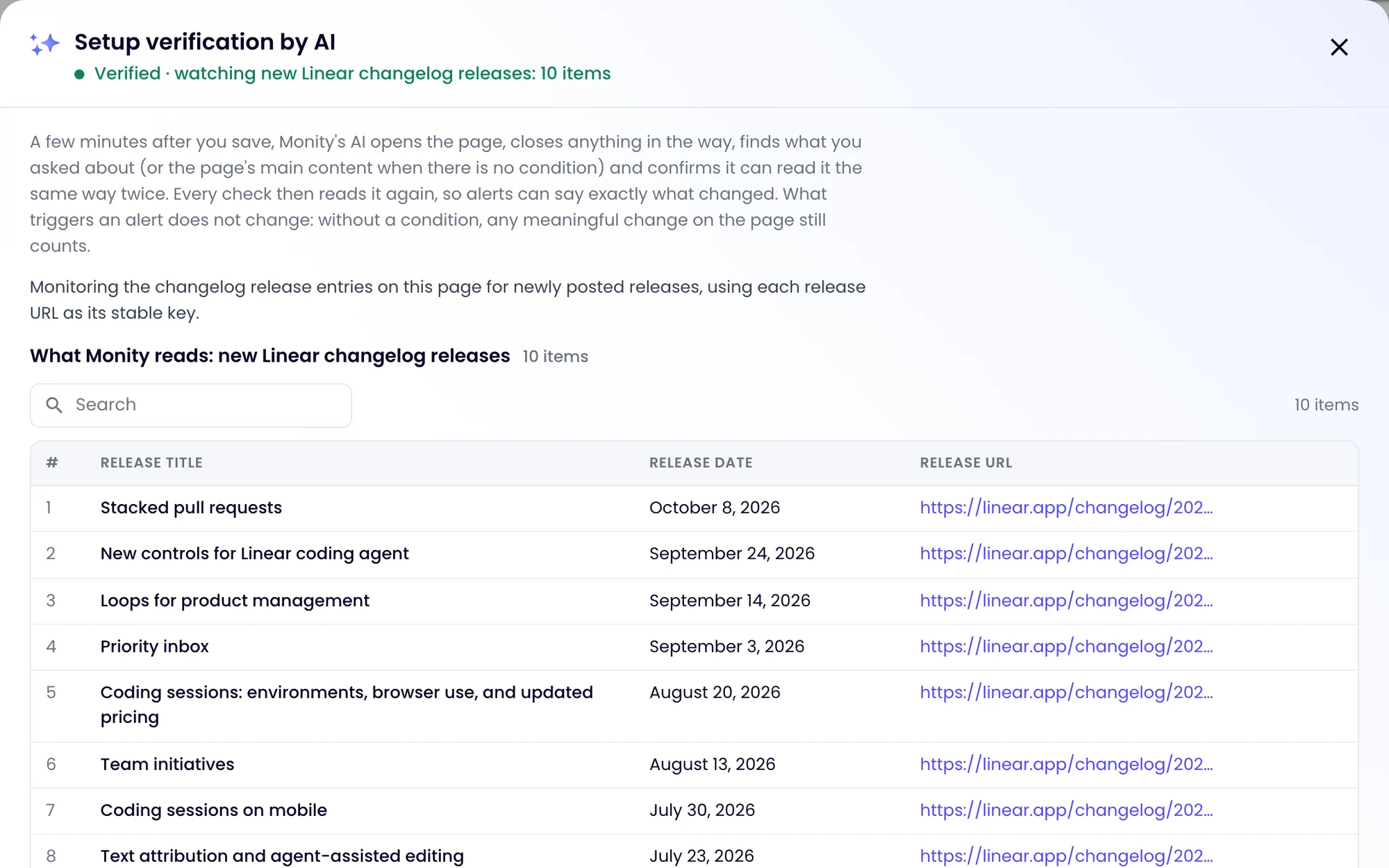
Each completed check keeps a screenshot in the task’s check history, including checks that send no alert, and you can compare it with the previous one (check history and comparisons). The history is subject to retention and starts with your first check: Monity can’t retrieve older snapshots and has no public archive to search.
Start free with Monity to keep a record of the next change.