Skip to content Use Monity from Claude, ChatGPT or Codex: set up monitors and ask what changed, from a chat. Use Monity from Claude, ChatGPT or Codex Connect yours
Comparison · Updated November 2026

Monity vs Checkly

Pick Checkly if your engineers want tests as Playwright code, managed from the command line and run from many locations. Pick Monity if the people who own sign-up and checkout are not going to write Playwright: tests are steps in plain words, or drafted by AI, and the same account watches uptime and what your pages say.

  • Free basic plan
  • No credit card
  • Verified November 2026
Monity vs Checkly
Pick Monity if
  • You want browser tests without writing code
  • You also watch pages for changes
  • You want status pages and every alert channel included
Pick Checkly if
  • You want tests as Playwright code, with a CLI or Terraform
  • You need checks from many locations
  • You run large numbers of API checks

Checkly

Checkly is synthetic monitoring built for developers. Browser checks are Playwright scripts, uptime and API checks run from up to 21 locations, and plans are sized by the number of check runs. Checks can be managed as code with its CLI, Terraform or Pulumi.

New to testing without code? Read how to test login, sign-up and checkout automatically.

Feature comparison

Monity vs Checkly, feature by feature.

What each side includes, row by row. Checkly’s column is from its own pricing page, November 2026.

Capability
Monity
Checkly
Free plan
3 tasks (monitors or tests) and 100 credits a month
10 uptime monitors, 1,000 browser check runs and 10,000 API check runs a month
How browser tests are written
Steps in plain words, or drafted by Monity AI
Playwright scripts
Tests managed as code
CLI, Terraform and Pulumi
Run after a deploy
A trigger URL, with a ready GitHub Actions workflow
See Checkly’s site
A screenshot of every step
See Checkly’s site
How tests are billed
1 credit for each started minute of a run
By check runs a month
Uptime monitors
3 free; as many as the plan has tasks
10 on Hobby, 50 on Starter, 75 on Team
Fastest uptime checks
Every minute from Personal 1k ($10/mo billed yearly); every 30 seconds from Personal 10k and Business 20k
Every 2 minutes on Hobby, every minute on Starter, every 30 seconds on Team
Uptime protocols
HTTP(S), keyword, TCP port, DNS and heartbeat
HTTPS, TCP, DNS, ICMP, SSL/TLS, gRPC, traceroute and heartbeat
Check locations
Not yours to choose
6 on Hobby and Starter, 21 on Team
Alert channels
Email, Slack, Teams, Discord, Telegram, Google Sheets, webhooks and app push, on every plan
Email, Slack and webhooks on Hobby and Starter; every channel on Team
Status pages
Up to 20 on every plan
A separate plan: free for 250 subscribers, $9/mo billed yearly for 500
Page change monitoring
Not on the pricing page
Pricing

What you'd pay, side by side.

Plans differ in what they count, so compare what each includes. Check Checkly's current pricing page before you buy.

Monity
Free$03 monitors · 100 credits a month · uptime checks every 5 minutes
Personal 1k$10/mo20 monitors · 1,000 credits a month · uptime checks every minute · billed yearly ($12 monthly)
Business 5k$25/mo30 monitors · 5,000 credits a month · uptime checks every minute · billed yearly ($35 monthly)
Business 10k, 5 seats$50/mo100 monitors · 10,000 credits a month · uptime checks every minute · billed yearly ($70 monthly)
See all plans →
Checkly
Hobby$010 uptime monitors, every 2 minutes, 1,000 browser check runs, 10,000 API check runs
Starter$24/mo50 uptime monitors, every minute, 3,000 browser check runs, 25,000 API check runs · billed yearly
Team$64/mo75 uptime monitors, every 30 seconds, 12,000 browser check runs, 100,000 API check runs · billed yearly
Status pagesSold separately: Hobby $0, Starter $9/mo and Team $30/mo, billed yearly
Checkly pricing →

Prices as of November 2026.

Pros and cons

The honest trade-offs.

Monity

Pros

  • Tests are written as steps, so the person who owns the journey can write them
  • Monity AI drafts a test from a sentence, and drafting uses no credits
  • Uptime, page changes and browser tests on one credit plan
  • Every alert channel on every plan, and up to 20 status pages included
  • Failed runs are kept for 90 days, with a screenshot of every step

Cons

  • No tests as code: no CLI, Terraform or Pulumi
  • Tests run every 5 minutes at the fastest, and every 3 hours on the free plan
  • No choice of check location
  • A smaller free plan: 3 tasks and 100 credits a month

Checkly

Pros

  • Playwright scripts, managed as code with a CLI, Terraform or Pulumi
  • Checks from 6 locations on the free plan and 21 on Team
  • A larger free plan: 10 uptime monitors and 1,000 browser check runs
  • ICMP, gRPC and traceroute monitors

Cons

  • Browser checks are code, so someone has to write and maintain it
  • Status pages are a separate plan
  • Every alert channel needs the Team plan
Migration guide

Switching from Checkly.

  1. List your Checkly browser checks and what each one proves: the journey, the pages it visits and what it expects to see.
  2. In Monity, open Tests and describe each journey to Monity AI, or add the steps yourself: go to a page, click, type, wait, check. Drafting uses no credits.
  3. Put logins, API keys and two-factor seeds in an environment and mark them Secret.
  4. Set the schedule, and add the test’s trigger URL to your deploy so it runs after each release. The test page gives you the curl line and a GitHub Actions workflow.
  5. Add your uptime checks under Uptime, and choose where alerts go.
  6. Run Checkly and Monity side by side for a week before you cancel anything.

FAQ

Switching questions, answered

Do I need to write code to test a checkout in Monity?

No. A test is a list of steps such as go to a page, click, type, wait and check, written in plain words. Monity AI can draft the steps from a sentence, and drafting uses no credits. In Checkly a browser check is a Playwright script.

Is Monity cheaper than Checkly?

They count different things, so it depends on what you run. Checkly’s free plan is larger: 10 uptime monitors and 1,000 browser check runs a month, against Monity’s 3 tasks and 100 credits. Checkly Starter is $24 a month billed yearly. Monity Personal 1k is $10 a month billed yearly for 1,000 credits, where a test uses 1 credit for each started minute of a run and an uptime monitor checked every minute uses 44 a month.

Can Monity run tests after a deploy?

Yes. Every test and every folder of tests has a trigger URL. Call it from your CI or a deploy hook and Monity starts the runs. The test page gives you the curl line and a ready GitHub Actions workflow that fails the job when a test fails.

Which one checks from more locations?

Checkly: 6 locations on Hobby and Starter, 21 on Team. Monity does not let you choose where a check runs from.

What does Monity cover that Checkly does not list?

Changes to what a page says. Monity’s page monitors watch any page on a schedule and tell you what changed, with the page before and after. Status pages are included on every plan; at Checkly they are a separate plan.

Try Monity next to Checkly.

Add your three most important monitors on the free plan and run both for a week, or try every Business feature for 7 days.

  • Free plan: 3 tasks, no card
  • 7-day Business trial
  • Every alert channel on every plan
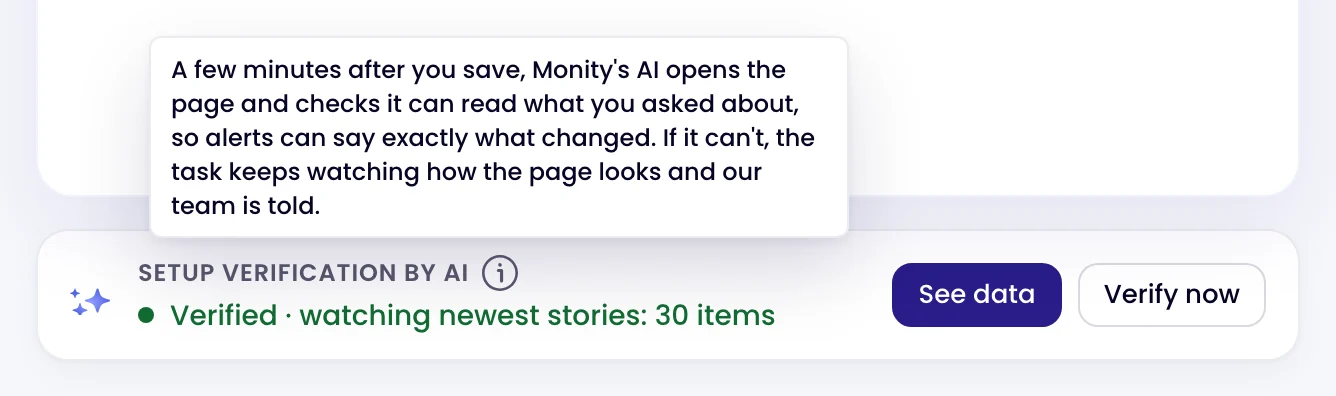
The Setup verification by AI card on a page monitor: Verified · watching newest stories: 30 items
Kamil, Alex and Martyna A person replies by email

Have a question?

Pricing, security or scoping: pick one and your message goes to a person on the team.