Better Stack does a lot: uptime monitoring, on-call schedules, phone call alerts, incident timelines, logs, metrics and status pages. That breadth is the reason to buy it, and also the reason people look elsewhere. If nobody on your team is on call, you are paying per responder for a platform built around a rota you do not have.
We make Monity, one of the tools below, so read our take with that in mind. Every price and limit here comes from each vendor’s own pricing page, checked on 18 November 2026. UptimeRobot shows its prices in euros.
Why people look for a Better Stack alternative
From what Better Stack’s own pricing page lists, the reasons are usually one of these:
- Pricing per responder. The paid plan starts with a Responder license at $29 per license per month billed annually ($34 monthly). It includes on-call, incidents and unlimited phone call alerts, whether or not you use them.
- Monitors come in packs. 10 monitors are included. Each additional 50 monitors is $21 per month billed annually ($25 monthly).
- Status pages add up. 1 status page is included. An additional public status page is $12 per month billed annually ($15 monthly), and removing the “Powered by Better Stack” footer is $208 per page per month billed annually ($250 monthly).
- The free plan is for personal projects. It has 10 monitors and heartbeats, 1 status page and alerts by Slack and email.
The short answer
- You want uptime checks, a status page and checks of what is on the page, with no on-call platform: Monity, which adds page change monitoring and browser tests to the same account.
- You want as many monitors as possible for free: UptimeRobot, whose free plan has 50 monitors checked every 5 min.
- You want a hundred monitors on a fixed plan: StatusCake, whose Superior plan has 100 uptime monitors checked every minute.
- Your engineers want checks as code: Checkly, with Playwright scripts and API checks.
- You mostly want the status page: Instatus, whose free Starter plan has 15 monitors and 200 subscribers.
- Someone has to be phoned when production is down: stay on Better Stack.
Better Stack alternatives compared
| Tool | Free plan | Paid plans from | Fastest checks | Status pages |
|---|---|---|---|---|
| Better Stack (for reference) | 10 monitors and heartbeats, 1 status page (personal projects) | Responder: $29 per license per month billed annually ($34 monthly) | Up to 30 seconds | 1 included; more at $12 per month billed annually |
| Monity (ours) | 3 monitors every 5 minutes, plus page checks | Personal 1k: $10/mo billed annually ($12 monthly) | Every 30 seconds (Personal 10k, Business 20k and up) | Up to 20 per account, on every plan |
| UptimeRobot | 50 monitors every 5 min | Solo: €9/month billed annually (€10 monthly) | Every 15 sec (Scale) | 1 basic page on Free; 3 with your own domain on Solo |
| StatusCake | 3 monitors every 15 minutes, personal use | Superior: $20.41/mo billed yearly ($24.49 monthly) | Every 30 seconds (Business) | Not covered here |
| Checkly | 10 uptime monitors, 1,000 browser checks | Starter: $24 per month billed annually | Every 30 sec (Team) | A separate plan, from $0 |
| Instatus | 15 monitors every 2 min, 200 subscribers | Pro (price not shown when we checked) | Every 30 sec (Pro) | Included; 5,000 subscribers on Pro |
The alternatives, one by one
Monity (ours)
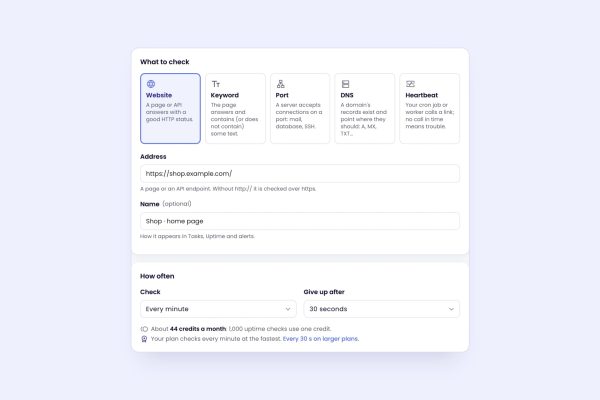
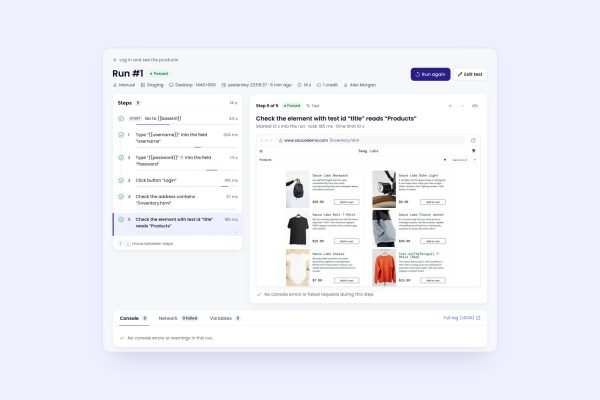
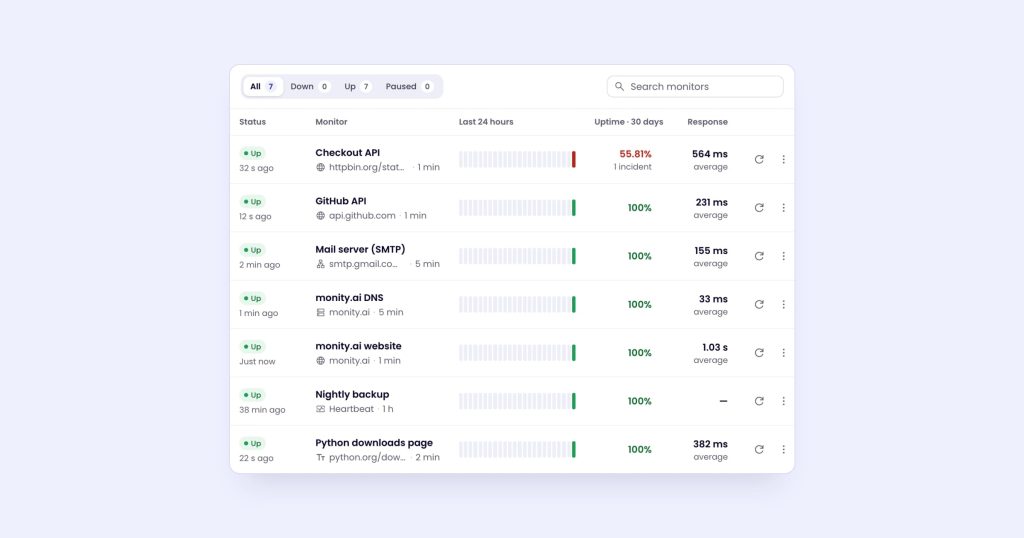
Monity is website monitoring for teams that do not run an on-call rota. An uptime monitor is a task like any other in the account: a website, a keyword, a port, a DNS record or a heartbeat for a cron job. Next to it sit page monitors, which tell you when what a page says has changed, and browser tests, which run sign-up, login and checkout step by step.
What’s different from Better Stack:
- No price per responder. Plans are sized by credits. A monitor checked every minute uses 44 credits a month, and Personal 1k is $10/mo billed annually ($12 monthly) with 20 tasks.
- Status pages are included. Up to 20 per account on every plan, with incident posts and email subscribers. Each page ends with a small “Monitored by Monity” line.
- Every alert channel on every plan. Email, Slack, Microsoft Teams, Discord, Telegram, Google Sheets, webhooks and push to the iOS and Android app.
- A failure is confirmed first. A failed check is retried twice, 3 and 6 seconds later, before the monitor counts as down.
- It reads the page. A site can answer 200 OK while the price on it is wrong or the checkout button does nothing. An uptime check will not see that.
The two are side by side in Monity vs Better Stack.
Pick something else when: an outage has to wake a named person. Monity has no on-call schedules, escalations or phone calls, and no logs or metrics. It also has no ping or UDP checks and no choice of check location.
Want to see it on your own site first?
Send us the sites, pages and journeys you check by hand. We set up the monitors, confirm they read the right thing and email you the first result, usually within a business day. Free, no account, no card.
UptimeRobot
UptimeRobot is the simplest swap if uptime is all you need. Its free plan has 50 monitors checked every 5 min, with HTTP, port, ping and keyword monitors. Solo is €9/month billed annually (€10 monthly) for 10 monitors checked every 60 seconds, and adds SSL and domain expiry, DNS, API and heartbeat monitoring and 3 status pages on your own domain. Team has 100 monitors checked every 30 sec with 3 login seats, and Scale checks every 15 sec.
Two things to know before you move: the free plan has only 5 integrations and no SSL or domain expiry monitoring, and there are no login seats below Team.
Pick it when: you want many monitors for little money and do not need on-call. See Monity vs UptimeRobot for how it differs from us.
StatusCake
StatusCake sells fixed plans with many monitors. Superior is $20.41/mo billed yearly ($24.49 monthly) for 100 uptime monitors with 1-minute test intervals and 2 team members, and it adds page speed, domain, SSL and server monitors. Business is $66.66/mo billed yearly ($79.99 monthly) for 300 uptime monitors with 30-second test intervals and 10 team members. The free plan is a single login for personal use, with 3 uptime monitors and 15-minute test intervals.
Pick it when: you have dozens of sites to watch and want one predictable price.
Checkly
Checkly is monitoring as code. Browser checks are Playwright scripts, and checks can be managed with its CLI, Terraform or Pulumi. The free Hobby plan has 10 uptime monitors, 1,000 browser checks and 10,000 API checks. Starter is $24 per month billed annually for 50 uptime monitors checked every 1 min, and Team is $64 per month billed annually with checks every 30 sec from 21 locations.
Pick it when: engineers own the monitoring and want it in the repository next to the code.
Instatus
Instatus starts from the status page and adds monitoring and on-call to it. The free Starter plan has 15 monitors checked every 2 min, a public status page and 200 subscribers. Pro has 50 monitors checked every 30 sec, 5 team members, a custom domain and 5,000 subscribers. The paid prices did not show on its pricing page when we checked.
Pick it when: the status page matters most and you want its monitors in the same tool. Our Statuspage alternatives post compares the status page tools.
When to stay on Better Stack
Stay when the thing you are buying is incident response, not uptime checks:
- On-call schedules and escalations, with unlimited phone call alerts on a Responder license.
- Logs, metrics, traces and error tracking in the same place as the alert, so the person who is woken can investigate.
- Checks Monity and others do not run: ping, UDP, mail servers, and checks from several locations.
- A 60-day money-back guarantee, if you want to try the whole platform.
How to switch without missing an outage
- List your Better Stack monitors and heartbeats: the address, the kind and the interval of each.
- Add them in the new tool and let both run side by side for a week.
- Check that an alert reaches the people who need it. Take one test monitor down on purpose.
- Move your status page last, and keep the old one up with a link to the new one until your customers have moved.
- Keep on-call where it is unless the new tool replaces it. Most of the tools above do not.
Try Monity on the sites you look after
Start on the free plan in a few minutes, or let us set it up and send you the first result. Slack, Teams, Google Sheets and every other alert channel are included either way.