StatusCake is a straightforward uptime monitor with fixed plans: a set number of monitors, a set check speed, one price. For a team with a hundred sites that is exactly right. People start looking elsewhere at the two ends: when they have three sites and the free plan checks them every quarter of an hour, or when “is it up?” stops being the only question they need answered.
We make Monity, one of the tools below, so read our take with that in mind. Every price and limit here comes from each vendor’s own pricing page, checked on 18 November 2026. UptimeRobot shows its prices in euros.
Why people look for a StatusCake alternative
From what StatusCake’s own pricing page lists, the reasons are usually one of these:
- The free plan is small. It has 3 uptime monitors with 15-minute test intervals, HTTP(S) tests only, a single login for personal use and 1 email address for email alerting.
- The first paid plan is a jump. Superior is $20.41/mo billed yearly ($24.49 monthly). That is good value for 100 uptime monitors, and a lot for someone who has five.
- Team members are set by the plan. Superior has 2 team members and Business has 10.
- Its plans are about availability. They are built from uptime, page speed, domain, SSL and server monitors. Knowing that the words or the price on a page changed, or that checkout still works, is a different kind of check.
The short answer
- You want uptime checks plus checks of what the page says and whether it works: Monity, which has uptime monitors, page change monitors and browser tests in the same account.
- You want as many monitors as possible for free: UptimeRobot, whose free plan has 50 monitors checked every 5 min.
- Someone has to be phoned when production is down: Better Stack, which is built around on-call.
- Your engineers want checks as code: Checkly, with Playwright scripts and API checks.
- You watch dozens of sites and want one predictable price: stay on StatusCake.
StatusCake alternatives compared
| Tool | Free plan | Paid plans from | Fastest checks | Beyond uptime |
|---|---|---|---|---|
| StatusCake (for reference) | 3 uptime monitors, 15-minute test intervals, personal use | Superior: $20.41/mo billed yearly ($24.49 monthly) | 30-second test intervals (Business) | Page speed, domain, SSL and server monitors |
| Monity (ours) | 3 monitors every 5 minutes, plus page checks | Personal 1k: $10/mo billed annually ($12 monthly) | Every 30 seconds (Personal 10k, Business 20k and up) | Page change monitors, browser tests, status pages |
| UptimeRobot | 50 monitors every 5 min | Solo: €9/month billed annually (€10 monthly) | Every 15 sec (Scale) | Status pages |
| Better Stack | 10 monitors and heartbeats, 1 status page (personal projects) | Responder: $29 per license per month billed annually ($34 monthly) | Up to 30 seconds | On-call, incidents, logs and metrics |
| Checkly | 10 uptime monitors, 1,000 browser checks | Starter: $24 per month billed annually | Every 30 sec (Team) | Playwright browser checks, API checks |
The alternatives, one by one
Monity (ours)
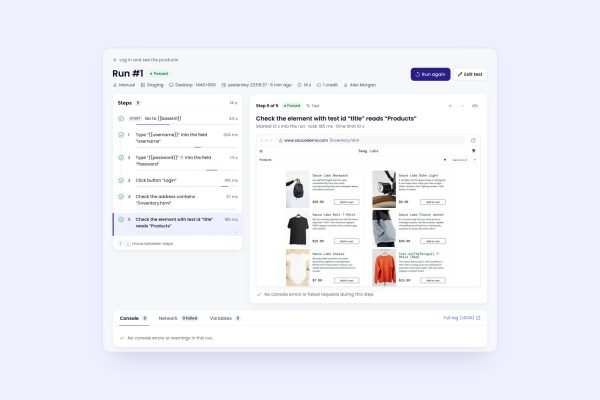
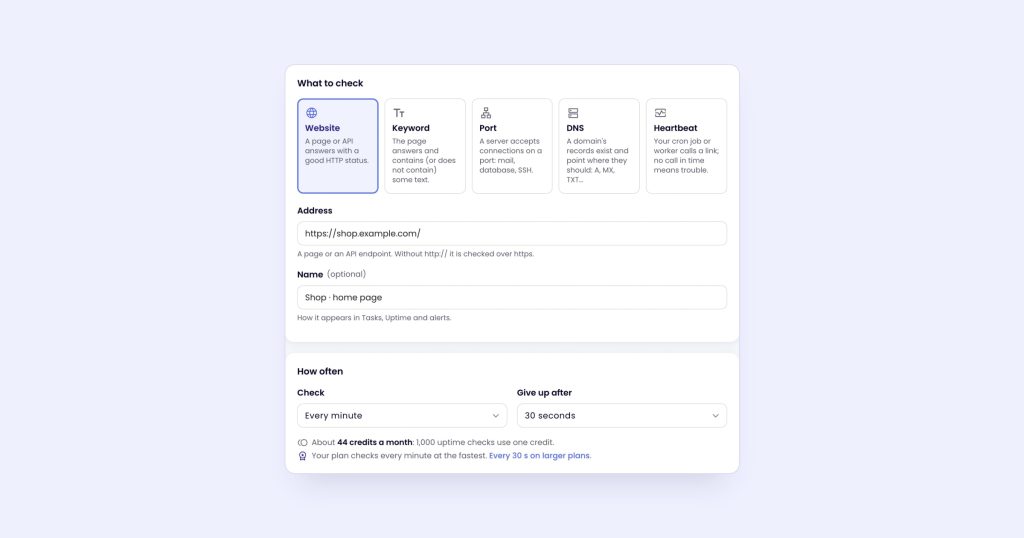
Monity is website monitoring in one account. An uptime monitor is a task like any other: a website, a keyword, a port, a DNS record or a heartbeat for a cron job. Next to it sit page monitors, which tell you when what a page says has changed, and browser tests, which run sign-up, login and checkout step by step.
What’s different from StatusCake:
- A smaller first step. Plans are sized by credits. A monitor checked every minute uses 44 credits a month, and Personal 1k is $10/mo billed annually ($12 monthly) with 20 tasks.
- The free plan checks faster. 3 monitors, checked every 5 minutes.
- Every alert channel on every plan. Email, Slack, Microsoft Teams, Discord, Telegram, Google Sheets, webhooks and push to the iOS and Android app.
- Status pages are included. Up to 20 per account on every plan, with incident posts and email subscribers.
- A failure is confirmed first. A failed check is retried twice, 3 and 6 seconds later, before the monitor counts as down.
- It reads the page. A site can answer 200 OK while the price on it is wrong or the checkout button does nothing. An uptime check will not see that.
The two are side by side in Monity vs StatusCake.
Pick something else when: you need a hundred monitors on the cheapest fixed plan, or the test types Monity does not run: ping, SSH and SMTP. Monity’s own server monitoring is on Business plans and for Linux servers only, for now, and Monity has no choice of check location.
Want to see it on your own site first?
Send us the sites, pages and journeys you check by hand. We set up the monitors, confirm they read the right thing and email you the first result, usually within a business day. Free, no account, no card.
UptimeRobot
UptimeRobot is the simplest swap if uptime is all you need. Its free plan has 50 monitors checked every 5 min, with HTTP, port, ping and keyword monitors. Solo is €9/month billed annually (€10 monthly) for 10 monitors checked every 60 seconds, and adds SSL and domain expiry, DNS, API and heartbeat monitoring and 3 status pages on your own domain. Team has 100 monitors checked every 30 sec with 3 login seats, and Scale checks every 15 sec.
Two things to know before you move: the free plan has only 5 integrations and no SSL or domain expiry monitoring, and there are no login seats below Team.
Pick it when: you want many monitors for little or no money. See Monity vs UptimeRobot for how it differs from us.
Better Stack
Better Stack is an incident platform with uptime monitoring inside it: on-call schedules, escalations, phone call alerts, logs and metrics. The free plan has 10 monitors and heartbeats and 1 status page, for personal projects. The paid plan starts with a Responder license at $29 per license per month billed annually ($34 monthly), with 10 monitors included and each additional 50 monitors at $21 per month billed annually ($25 monthly). Checks run up to 30 seconds apart.
Pick it when: an outage has to reach a named person on a rota. Our Better Stack alternatives post covers it in more detail.
Checkly
Checkly is monitoring as code. Browser checks are Playwright scripts, and checks can be managed with its CLI, Terraform or Pulumi. The free Hobby plan has 10 uptime monitors, 1,000 browser checks and 10,000 API checks. Starter is $24 per month billed annually for 50 uptime monitors checked every 1 min, and Team is $64 per month billed annually with checks every 30 sec from 21 locations.
Pick it when: engineers own the monitoring and want it in the repository next to the code. Our Checkly alternatives post compares the tools that test user journeys.
When to stay on StatusCake
Stay when the plan fits the number of sites you watch:
- 100 uptime monitors with 1-minute test intervals on Superior, for $20.41/mo billed yearly. None of the alternatives above is cheaper at that size.
- Page speed, domain and server monitors in the same plan: 15 page speed monitors, 50 domain monitors and 3 server monitors on Superior.
- Test types beyond HTTP: DNS, HEAD, PING, PUSH, SMTP, SSH and TCP on the paid plans.
- Scheduled reports, daily, weekly or monthly.
How to switch without missing an outage
- List your StatusCake tests: the address, the test type and the interval of each.
- Add them in the new tool and let both run side by side for a week.
- Check that an alert reaches the people who need it. Take one test monitor down on purpose.
- Move your status page, if you have one, last.
- Cancel the old plan only after a week in which both tools agreed.
Try Monity on the sites you look after
Start on the free plan in a few minutes, or let us set it up and send you the first result. Slack, Teams, Google Sheets and every other alert channel are included either way.