


FDA lists its warning letters in a public table on fda.gov, newest first: when each letter was posted and issued, the company, the FDA office that sent it, a short subject, and links to the company’s reply and FDA’s close-out letter when they exist. You can search, filter and export the table for free. To hear only about letters from one FDA center, with one subject or to a company you work with, watch the table with a page monitor in Monity (monity.ai). It checks on your schedule and sends the matching rows to email, Slack, Microsoft Teams or a Google Sheet.
The columns, dates and examples below were read on FDA’s pages and in the letters themselves on 23 November 2026.
What the FDA Warning Letters table shows
FDA’s Warning Letters page needs no account. It shows 10 rows at a time, sorted by posted date, and can show 25, 50 or 100. On 23 November, all ten newest rows had been posted on Tuesday 17 November 2026.
| Column | What it holds |
|---|---|
| Posted Date | When FDA put the letter online. |
| Letter Issue Date | When FDA issued the letter. In the 17 November batch, letters went online 7 to 179 days after they were issued (36 days was the median). |
| Company Name | The company or person the letter went to. It links to the full letter. |
| Issuing Office | The FDA center or office, such as the Center for Drug Evaluation and Research (CDER), the Center for Devices and Radiological Health (CDRH), the Center for Tobacco Products, the Human Foods Program or the Office of Inspections and Investigations. |
| Subject | FDA’s short tags for the problem, such as CGMP/Finished Pharmaceuticals/Adulterated/OTC, CGMP/Active Pharmaceutical Ingredient (API)/Adulterated or Foreign Supplier Verification Program (FSVP). |
| Response Letter | A link to the company’s reply, when FDA has posted one. |
| Closeout Letter | A link to FDA’s close-out letter, once one has been issued. |
Above the table you can search the letters, filter by issuing office, by letter issue date or posted date (last 7, 30, 60 or 90 days), by year, and by whether a response or close-out letter exists, and export the rows to Excel.
Three recent letters, as FDA lists them:
- Natural Essentials, Inc. (CMS 738543): CDER, issued 10 November 2026, posted 17 November, subject
CGMP/Finished Pharmaceuticals/Adulterated/OTC. - Chirp Innovations, LLC (CMS 731847): CDRH, 2 October 2026, about an over-the-counter TENS and EMS unit, with Quality System Regulation violations.
- Advance-Esthetic LLC (CMS 729267): CDRH, 25 August 2026, about three Zemits aesthetic devices sold without the approval or clearance FDA says they need.
Warning letters FDA sends to tobacco retailers after compliance check inspections are listed on their own page, and drug marketing letters, including Untitled Letters to drug companies, have another (both linked from About Warning and Close-Out Letters). The Center for Tobacco Products’ other letters, for example to online vape sellers, are in the main table: four of the ten newest rows on 23 November.
FDA adds a warning above the table: “Matters described in FDA warning letters may have been subject to subsequent interaction between FDA and the letter recipient that may have changed the regulatory status of issues discussed in the letter.”
Form FDA 483, Warning Letter and Close-Out Letter
“FDA 483 warning letter” is a common search, but these are three different documents:
| Document | When FDA issues it | Reply | Where to find it |
|---|---|---|---|
| Form FDA 483 (inspectional observations) | At the end of an inspection, listing what the investigators observed. FDA says it “does not constitute a final Agency determination” (Form 483 FAQ). FDA weighs it with the inspection report, the evidence and the company’s replies before deciding what to do. | Before issuing a warning letter, FDA “will generally allow firms 15 business days” to reply to a 483 (FDA notice, 74 FR 40211, 2009). | Not in the Warning Letters table. Some are posted in the OII FOIA Electronic Reading Room. |
| Warning Letter | When FDA finds what it believes are significant violations, such as poor manufacturing practices or claims a product can’t back up. | The letter sets the deadline. The CDER letters posted on 17 November asked for a reply “within fifteen (15) business days of receipt”, and the Human Foods Program, Office of Inspections and Investigations and tobacco letters within 15 working days. | The Warning Letters table. |
| Close-Out Letter | For warning letters issued on or after 1 September 2009, once FDA has verified the corrections, usually at a follow-up inspection. FDA doesn’t issue one on a promise to fix, or when the violations by their nature can’t be corrected. | None. | The Closeout Letter column, on the original letter’s row. |
Free ways to follow new letters
- FDA’s own table. Once a week, set Posted Date to the last 7 days, read the rows and export them to Excel if you keep a log.
- FDA’s email alerts. On Get Email Updates you choose from the topics FDA offers.
If a weekly look covers it, FDA’s tools are free and enough. A monitor helps when you want only some letters (one center, one subject, a list of suppliers), or want them in a shared channel or sheet without anyone remembering to look.
How to set up FDA warning letter alerts in Monity
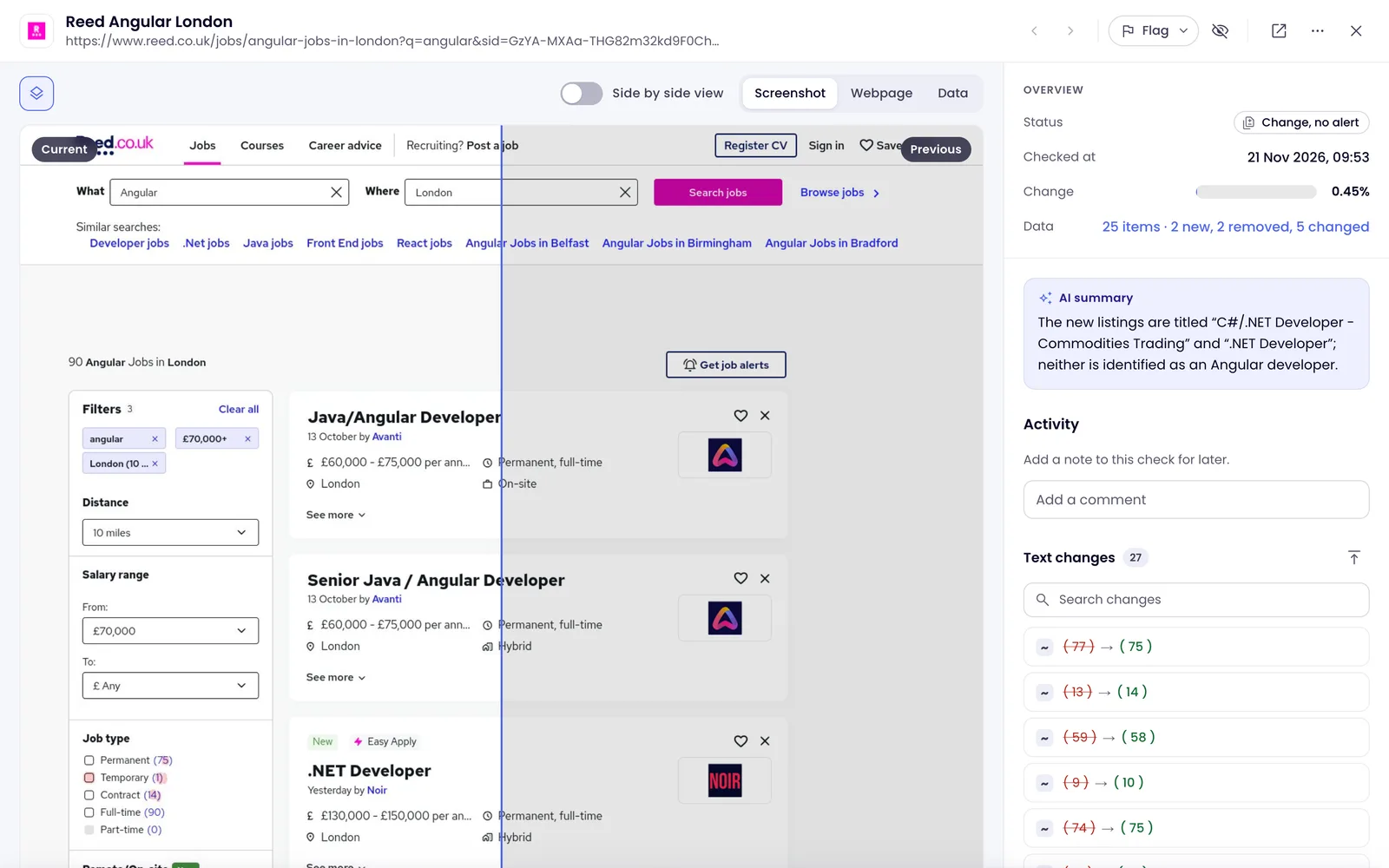
A Monity page monitor opens the page in a real browser on your schedule, keeps a screenshot of every check, and alerts you only when a change matches the rule you wrote.
- Create a page monitor for the Warning Letters page, or click Ask Monity and paste the address.
- Show 100 rows before each check. Add a browser step that sets the table’s row count to 100. The page shows 10 rows by default and the 17 November batch alone filled all ten, so a bigger batch would push letters past what a default check reads.
- Write the rule in a sentence, using what the table shows:
- “Tell me when a new letter from the Center for Drug Evaluation and Research (CDER) has CGMP in its subject. Include the company, issue date and subject.”
- “Tell me when a new letter is posted for any of these companies: [Company A], [Company B], [Company C].” Write the names as FDA does, with Inc. or LLC.
- “Tell me when a new letter is posted by the Center for Devices and Radiological Health (CDRH).”
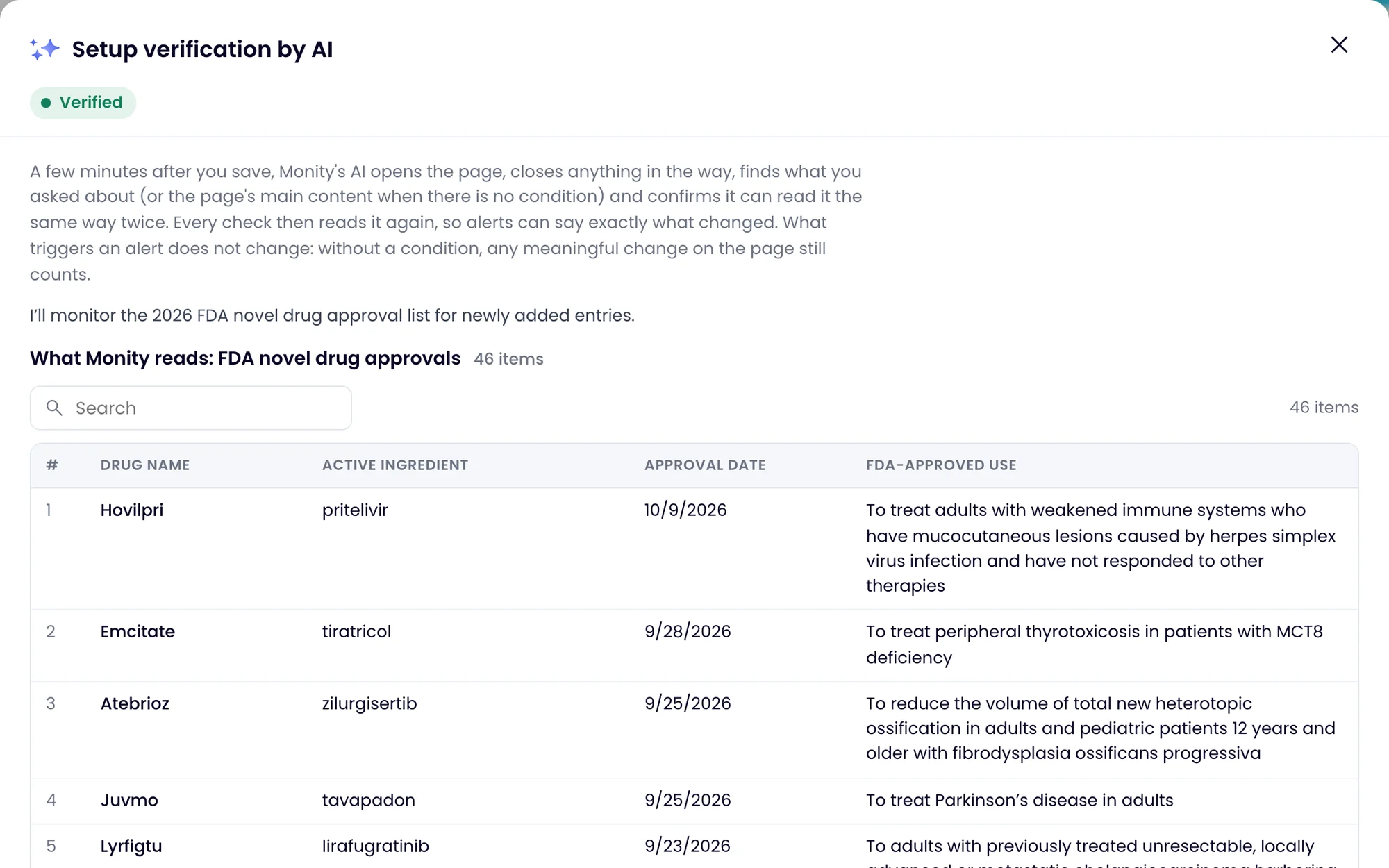
- Look at the first check. A few minutes after you save, Monity’s AI checks that it reads the rows the same way twice. Then open the first check and make sure the screenshot and the rows Monity read show 100 letters, not ten. The first ten rows are in the page’s HTML and the table script adds the row-count menu after the page opens, so if you see only ten, add a short wait before the row-count step (browser actions).
How often to check, and what it costs
FDA posted its latest batch on a single day, so a daily check is enough for most teams. One check uses one credit.
- Daily: about 22 credits a month on weekdays, 30 every day. That fits the Free plan (3 monitors, 100 credits a month, page checks every 3 hours at most).
- Hourly, 8 a.m. to 6 p.m. Eastern on weekdays: about 220 to 240 credits a month. That fits Personal Small (1,000 credits, $10 a month billed yearly) or Business Small (5,000 credits and 3 seats, $25 a month billed yearly). See pricing.
Alerts go to email, Slack, Microsoft Teams, Discord, Telegram, a webhook or the Monity phone app. With the Google Sheets integration, every alert is added as a row: the time, the monitor, its URL and label, and the AI summary. That gives quality and regulatory teams a running log.
What Monity doesn’t do
- It sees a letter only once FDA posts it. In the 17 November batch, that was 7 to 179 days after the issue date.
- It reads the table, not the letters. A rule can match what the table shows (company, office, subject, dates). It can’t match a regulation cited inside a letter.
- It doesn’t find Form 483s that aren’t public. Some are in the OII FOIA Electronic Reading Room, which you can watch with a page monitor too.
- It isn’t legal or regulatory advice. Monity tells you FDA posted or changed a row. Your team reads the letter.
Related: FDA drug shortage list monitoring, EMA safety warning and PRAC update alerts, regulatory compliance monitoring and Monity for healthcare.