


Atlassian Statuspage has a free plan and four paid plans for public status pages, from $29 to $1,499 a month, priced by subscribers, team members and metrics. Private pages for employees start at $79 a month, and audience-specific pages at $300 (Atlassian’s pricing page, read on 23 November 2026). If you mostly need a public page with your uptime on it, there are cheaper options, monity.ai among them, compared below with the same day’s prices.
Statuspage pricing for public pages
| Plan | Price a month | Subscribers | Team members | Metrics | Custom domain |
|---|---|---|---|---|---|
| Free | $0 | 100 | 2 | 2 | Not listed |
| Hobby | $29 | 250 | 5 | 5 | Yes |
| Startup | $99 | 1,000 | 10 | 10 | Yes |
| Business | $399 | 5,000 | 25 | 25 | Yes |
| Enterprise | $1,499 | 25,000 | 50 | 50 | Yes |
The free plan also lists 25 components, email, Slack and Microsoft Teams notifications, and the REST API. Startup adds team member SSO (with Atlassian Guard) and Business role-based access control. Atlassian shows no yearly prices: its FAQ says yearly billing is “manual and requires a signed order form.”
Private and audience-specific pages
| Private page plan | Price a month | Employees | Team members |
|---|---|---|---|
| Starter | $79 | 50 | 5 |
| Growth | $249 | 300 | 15 |
| Corporate | $599 | 1,000 | 35 |
| Enterprise | $1,499 | 5,000 | 50 |
Audience-specific pages, which show different components to different groups, start at $300 a month with 25 team members, 10 groups and 500 users.
What sets your Statuspage price
Usually the subscriber count. A page with 300 email subscribers is past Hobby’s 250, so it needs Startup at $99 a month, even if two people run it. The same jump happens at 1,000 and 5,000 subscribers, and with team members: a sixth person moves you from Hobby to Startup.
Cheaper status pages, compared
Prices from each company’s own pricing page on 23 November 2026. Monity’s are from its pricing page.
| Tool | Free | First paid step | Subscribers | Your own domain | Monitoring included |
|---|---|---|---|---|---|
| Atlassian Statuspage | 1 page, 100 subscribers | Hobby: $29 a month | 250 on Hobby | From Hobby | Not on its pricing page |
| Better Stack | 10 monitors and heartbeats, 1 status page, for personal projects | Responder: $34 a month ($29 billed yearly); extra page $15 ($12) | 1,000 included; +1,000 for $40 a month | “status.yourdomain.com” | Yes: uptime checks up to every 30 seconds |
| Instatus | 15 monitors (2-minute checks), 200 subscribers, no custom domain | Pro: “from $20/mo” | 5,000 on Pro | From Pro | Yes: 50 monitors, 30-second checks on Pro |
| UptimeRobot | 50 monitors (5-minute checks), basic status pages | Solo: €9 a month billed yearly (€108 a year), €10 monthly; 3 status pages | Not readable on its page | From Solo | Yes: 10 monitors, 60-second checks on Solo |
| monity.ai | 3 monitors, uptime checks every 5 minutes | Personal Small: $10 a month billed yearly ($12 monthly), 20 monitors, uptime every minute | Email subscribers (they confirm once) | Not offered: pages live at app.monity.ai/status/ | Yes: the page is built from your uptime monitors |
Where each one is the better pick
- Statuspage: when you need private pages for employees, pages that show different parts to different audiences, or 25,000 subscribers on one public page.
- UptimeRobot: the most monitors for free (50), and your own domain on a status page from €108 a year.
- Instatus: 15 free monitors with 200 subscribers, and 30-second checks from Pro.
- Better Stack: when the status page sits next to on-call: its pricing page lists unlimited phone call alerts.
- monity.ai: when the status page is one part of watching your site. The same account has uptime monitors, page change monitors and browser tests, with every alert channel on every plan, the free one included; paid plans start at $10 a month billed yearly. It has no custom domain for status pages and no on-call schedules.
What a monity.ai status page includes
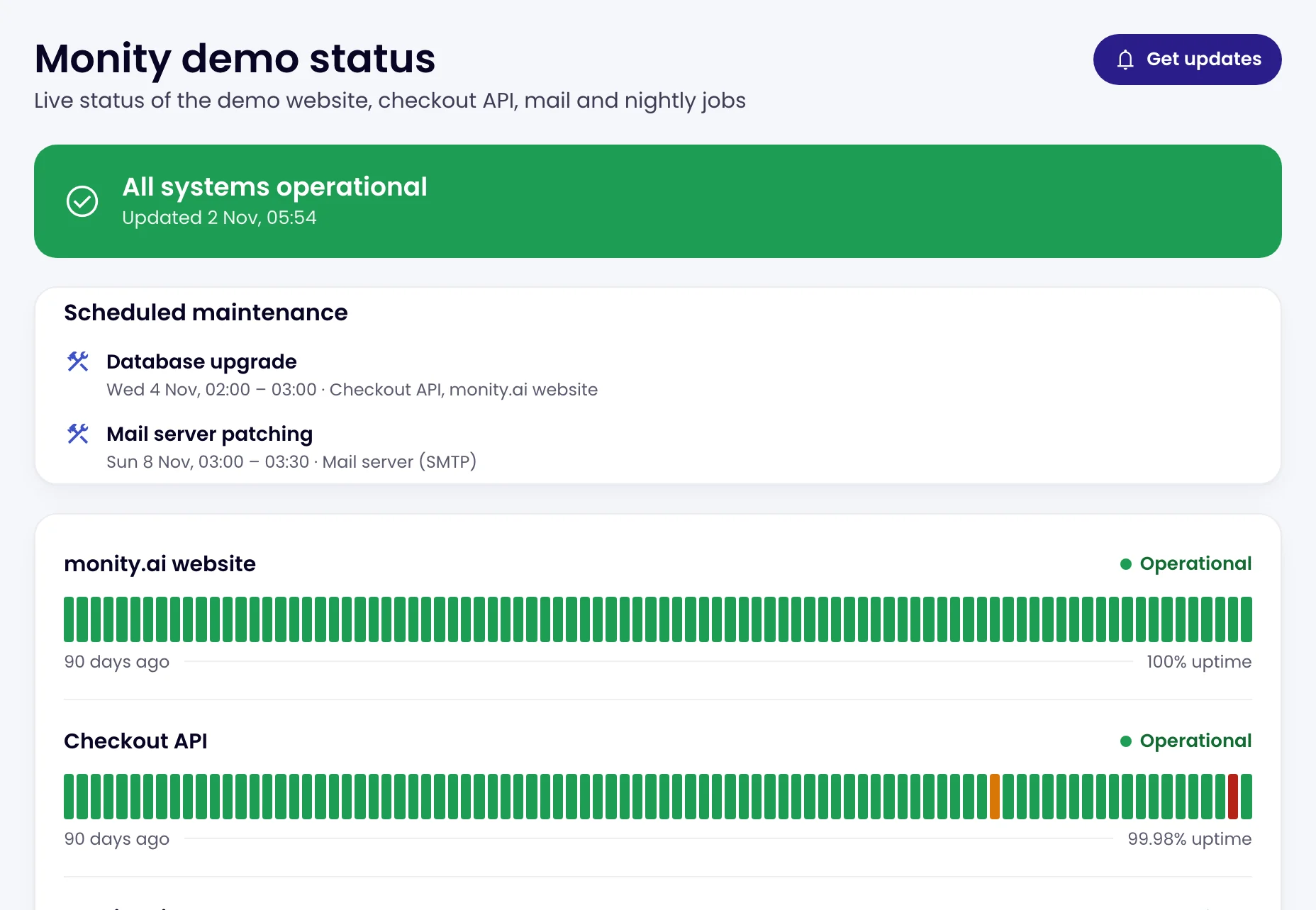
A public page built from your uptime monitors, showing each service by name, never its address or errors, with 90 days of daily history, recent incidents and scheduled maintenance. You post incident and maintenance updates, and email subscribers receive the posts you send. It can carry your logo and an accent colour, and it always ends with a small “Monitored by Monity” line. Each page has an SVG status badge, and you can have up to 20 pages per account. Uptime monitors check websites, APIs, keywords, ports, DNS records and cron jobs, every 30 seconds to every hour by plan, and confirm a failure with two re-checks before they alert.
For a wider look at the alternatives, read Statuspage alternatives and Monity vs Statuspage.