


CNAME and TXT lookup: check DNS aliases and text records
A CNAME lookup shows which name an alias points to. A TXT lookup shows a name’s text records, such as SPF, DMARC and site verification tokens. Enter a name to see either from four public resolvers, with TTLs and what each record means.
How it works
-
Choose CNAME or TXT
CNAME for an alias such as www.example.com; TXT for SPF on the domain itself, or DMARC at _dmarc.example.com.
-
Enter the exact name
Records belong to one name: the domain, a subdomain, or a name a service gave you, underscores included.
-
Read the records and notes
Each record is listed once, TXT records with their kind, plus what the standards say about what was found.
Monity’s free CNAME and TXT lookup asks Cloudflare, Google Public DNS, DNS4EU and CIRA Canadian Shield for one name’s records at the same moment. You see each record once, with the lowest TTL any resolver gave and whether all four agree. TXT records are labelled by the standard they follow.
CNAME or TXT: which to look up
| Record | What it holds | Seen on 24 Nov 2026 |
|---|---|---|
| CNAME | The name this name is an alias of | www.github.com is an alias of github.com |
| TXT at the domain | SPF, and tokens services use to check you own the domain | example.com: v=spf1 -all (sends no mail) and one token |
| TXT at _dmarc | The DMARC policy | _dmarc.gmail.com: p=none, sp=quarantine |
Reading a CNAME result
A CNAME sends every lookup of the name to its target, so the target’s A and AAAA records decide where visitors land. No CNAME means the name isn’t an alias: it may have its own addresses, which the DNS propagation checker shows. A name can have one CNAME only (RFC 2181, 10.1), and nothing else beside it, which is why the domain you registered can’t be one.
Reading TXT records
| Kind | Starts with | Lives at | Standard |
|---|---|---|---|
| SPF | v=spf1 | the domain | RFC 7208 |
| DMARC | v=DMARC1 | _dmarc.example.com | RFC 7489 |
| DKIM key | v=DKIM1 (optional) | selector._domainkey.example.com | RFC 6376 |
| MTA-STS | v=STSv1 | _mta-sts.example.com | RFC 8461 |
| TLS reporting | v=TLSRPTv1 | _smtp._tls.example.com | RFC 8460 |
Everything else is shown as “Other text”. Most of it is ownership tokens that a search console, an email service or a certificate authority asked you to publish. Their formats differ by service, so the lookup doesn’t guess which is which: compare the value with the one the service gave you. A long record split into several strings is shown joined, as receivers read SPF.
Problems the notes catch
- Two SPF records at one name. SPF then fails for every message (RFC 7208, 4.5). Merge them.
- SPF ending in
+allor a bareall. Any server passes SPF for your domain. - A DMARC record at the domain itself. Receivers ignore it: DMARC is read only at _dmarc.
- DMARC
p=none. Receivers are asked for no action on failing mail, so the policy only collects reports.quarantineorrejectasks them to act. - Two CNAMEs at one name, a CNAME that points at itself, and resolvers that disagree after a change.
What this lookup doesn’t check
It reads one name and one record type. It doesn’t follow a CNAME’s target, count SPF’s DNS lookups (receivers stop at 10, RFC 7208, 4.6.4), or test that a DKIM key verifies a signature. For mail servers, use the MX lookup. Answers are kept for 30 seconds to limit repeat queries.
Watch DNS records with Monity
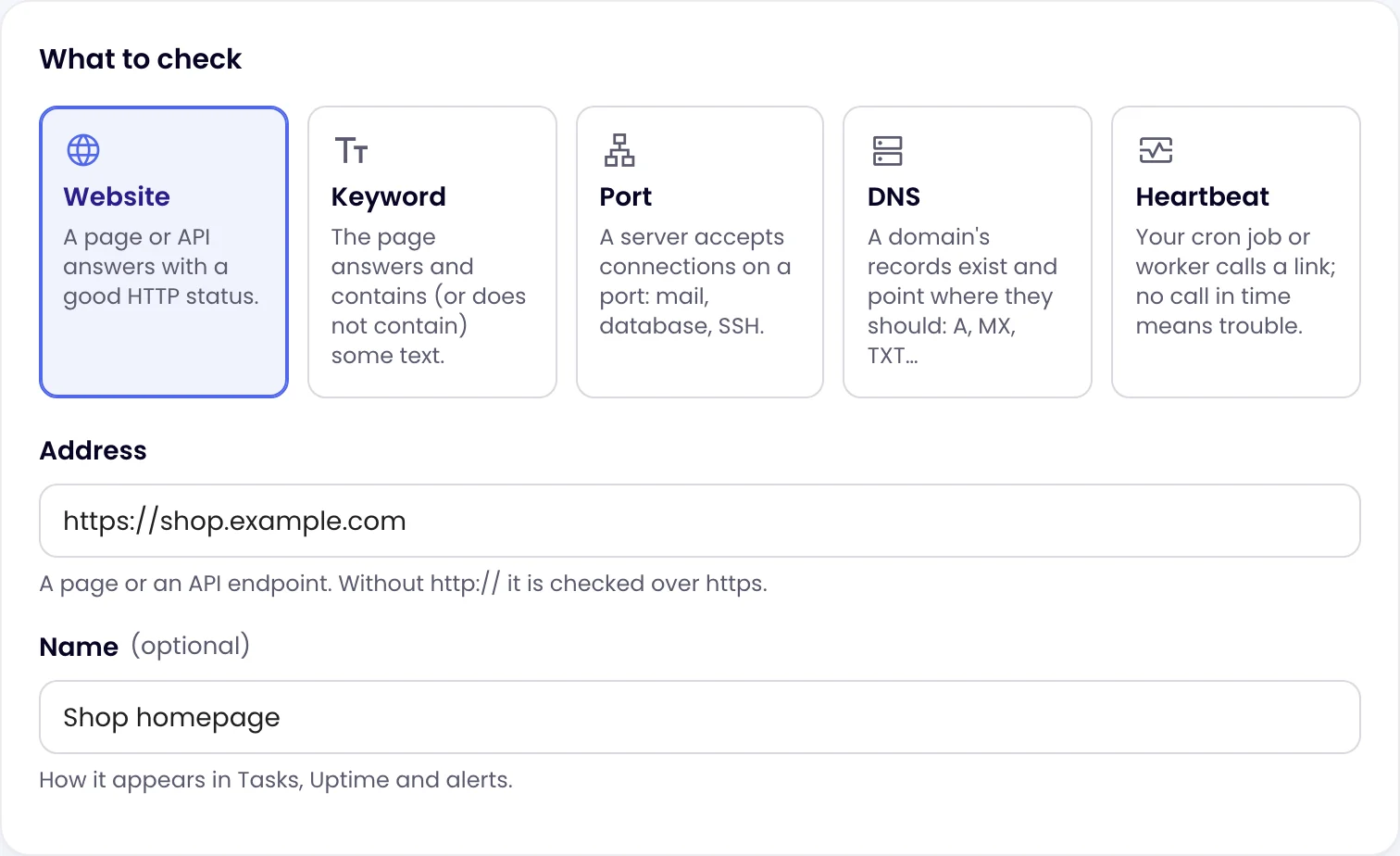
A changed CNAME can send visitors somewhere else, and a deleted SPF or DMARC record can push your mail into spam folders. In uptime monitoring, a DNS monitor checks a name’s CNAME or TXT records on a schedule and alerts you when a value you expect is missing (monitor types).
FAQ
Common questions
What is a CNAME record?
A CNAME (canonical name) record makes one name an alias of another. When a browser looks up www.example.com and finds a CNAME to example.net, it looks up example.net and connects to that name’s addresses.
Why can’t my root domain be a CNAME?
A CNAME can’t share its name with any other record (RFC 1912, section 2.4), and the domain you registered always has NS and SOA records. Some DNS providers offer a substitute, often called ALIAS, ANAME or CNAME flattening, that answers with the target’s addresses instead.
Where do I find a domain’s DMARC and DKIM records?
DMARC is a TXT record at _dmarc.example.com. A DKIM key is a TXT record at selector._domainkey.example.com. The selector is in the s= tag of the DKIM-Signature header of a message the domain sent.
Why does my domain have two SPF records, and does it matter?
It matters. RFC 7208 allows one SPF record per name: with two, receivers return a permanent error and SPF fails for every message. It happens when a second email service’s record is added beside the first. Merge them into one v=spf1 record.
How do I check CNAME and TXT records from the command line?
nslookup -type=cname www.example.com on Windows, macOS or Linux; dig TXT example.com +short on macOS or Linux; Resolve-DnsName -Name _dmarc.example.com -Type TXT in Windows PowerShell.
Can Monity alert me when a CNAME or TXT record changes?
Yes. A DNS monitor in Monity checks a name’s CNAME or TXT records on a schedule and alerts you when a value you expect is missing, as often as every 5 minutes on the free plan. Alerts go to email, Slack, Microsoft Teams, Discord, Telegram, Google Sheets, webhooks or the phone app.
What is a TXT record?
A TXT record (DNS type 16) holds text whose meaning depends on the name it is published at (RFC 1035, section 3.3.14). Domains use them for email authentication, SPF at the domain (RFC 7208) and DMARC at _dmarc.example.com (RFC 7489), and for the ownership tokens that services such as search consoles ask you to publish.
Catch a DNS record that disappears.
Set up a DNS monitor.
Monity checks your CNAME and TXT records from its own servers and alerts you when a value you expect is missing.
- Free 7-day trial
- No credit card
- 3 monitors free, forever