


SPF, DKIM and DMARC checker: test a domain’s email records
Enter a domain to check its SPF record and every include it reaches, counted against the limit of 10 DNS lookups, and its DMARC policy. Add a DKIM selector to check that key too. Each finding says in plain English what receivers will do with your mail.
How it works
-
Enter the domain
The part of your email address after the @, or the whole address. Add the DKIM selector if you know it.
-
Read the three records
SPF with every include it reaches and its lookup count, DMARC with the policy that applies, and the DKIM key.
-
Fix what is flagged
Each finding names the RFC rule behind it and the change that clears it.
Monity’s free SPF, DKIM and DMARC checker reads the three records receivers use to decide whether mail from your domain is genuine. It follows your SPF record through every include and counts the DNS lookups against the limit of 10. It reads the DMARC policy that applies to your domain and, for a selector you give, the size and settings of the DKIM key.
What the checker reads
| Record | Where it lives | What it tells receivers | Standard |
|---|---|---|---|
| SPF | a TXT record at the domain, starting v=spf1 | which servers may send mail for the domain | RFC 7208 |
| DMARC | a TXT record at _dmarc.example.com | what to do with mail that fails, and where to send reports | RFC 7489 |
| DKIM key | a TXT record at selector._domainkey.example.com | the public key that verifies a message’s signature | RFC 6376 |
Why SPF stops at 10 DNS lookups
A receiver may make at most 10 DNS lookups while it evaluates your SPF record (RFC 7208, 4.6.4). Past that it returns a permanent error, and SPF fails for every message, even from your own servers. The count includes the lookups inside every record you include, so it grows when a provider adds to its own record.
| Term | Counts as a lookup | What it matches |
|---|---|---|
include:, redirect= | yes, plus everything in the record it names | another domain’s SPF record |
a, mx, exists | yes | the domain’s addresses, its mail servers, or a name that exists |
ptr | yes, and RFC 7208 says not to use it | the sender’s reverse DNS name |
ip4:, ip6:, all | no | an address range, or everyone left |
On 24 Nov 2026 gmail.com published v=spf1 redirect=_spf.google.com, and that record listed ten
address ranges and ended in ~all: one lookup in total. A record with an include for each of eleven
services fails before a receiver reads the end. To make room, remove includes for services you no longer use, and
write fixed servers as ip4: or ip6: ranges.
How an SPF record is written
- Start with
v=spf1. One SPF record per name: with two, SPF fails (RFC 7208, 4.5). - List what may send:
ip4:andip6:for your own servers,include:for each service, with the name the service gives you. - End with how to treat everyone else:
-all(fail),~all(softfail, accepted but marked) or?all(neutral). Never+allor a bareall: they let any server pass.
A domain that sends no mail at all can publish v=spf1 -all.
Reading a DMARC record
| Tag | Means | gmail.com on 24 Nov 2026 |
|---|---|---|
p | the policy for mail that fails: none, quarantine or reject (required) | none |
sp | the policy for subdomains, when it differs | quarantine |
rua | where receivers send daily aggregate reports | an address at google.com |
pct | the share of failing mail the policy applies to (100 when left out) | left out |
adkim, aspf | strict (s) or relaxed (r, the default) alignment | left out |
A name with no DMARC record of its own takes the policy of its registered domain: mail from news.example.com falls
under _dmarc.example.com, with its sp if it has one
(RFC 7489, 6.6.3). Two DMARC records at one name
mean no policy at all. Reports sent to another domain’s address only arrive if that domain publishes a record
allowing them (section 7.1).
Finding your DKIM selector
A DKIM key lives at a name only the selector reveals, so no tool can list a domain’s keys. To find yours:
- Open a message the domain sent and view its headers. In Gmail: the three-dot menu, then Show original.
- Find the
DKIM-Signatureheader.s=is the selector andd=the domain that signed. - Enter both above. Each service that signs your mail has its own selector, so check each one.
Google Workspace’s default selector is google
(Google Workspace Admin Help), and Microsoft 365 publishes
selector1 and selector2 as CNAMEs to its own keys
(Microsoft Learn).
The checker reads key sizes: RSA keys under 1,024 bits are refused by receivers and 2,048 bits is the size signers
should use (RFC 8301). An empty p= means the key
was revoked.
What the checker doesn’t do
It reads DNS only: it doesn’t send or receive mail, so it can’t tell whether a real message passed. It doesn’t verify
a signature with the key, follow SPF macros (a receiver expands them per message), check whether an a
or mx term finds addresses, or read the record that lets another domain receive your DMARC reports. It
reads up to 20 SPF records per check and says when it stopped. The registered domain is found from the last two
labels, or three under names such as co.uk. Answers are kept for one minute. For the mail servers themselves, use the
MX lookup; for any other TXT record, the
CNAME and TXT lookup.
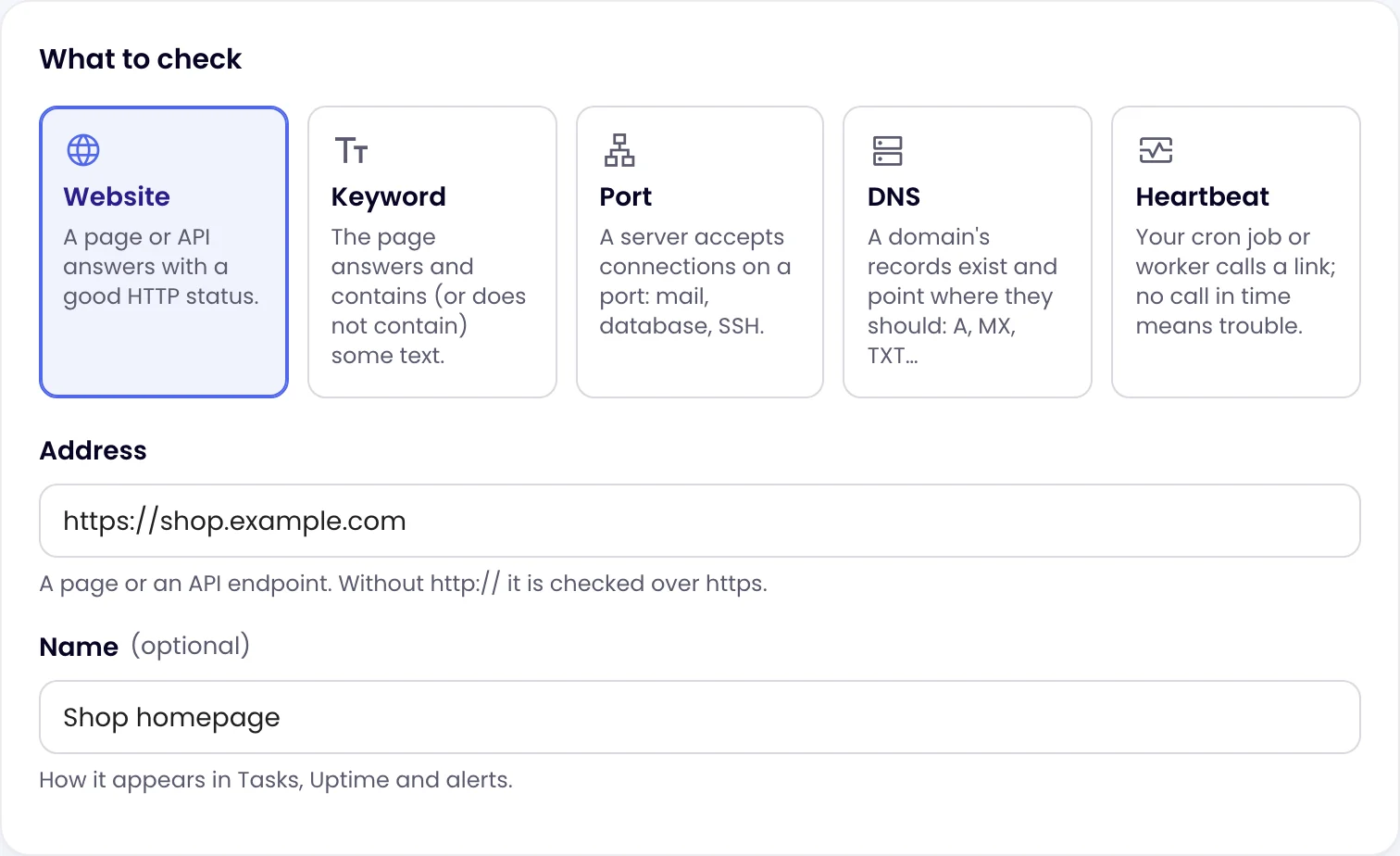
Watch the records with Monity
An SPF include that a provider renames, a DMARC record deleted in a DNS clean-up or a DKIM key rotated away can send your mail to spam with no error anywhere. In uptime monitoring, a DNS monitor checks a name’s TXT records on a schedule and alerts you when a value you expect is missing. Enter your whole SPF or DMARC record as that value, and any change to it or its removal raises an alert (monitor types).
FAQ
Common questions
How do I check my SPF record?
Enter your domain above. The checker reads the TXT record at the domain that starts with v=spf1, follows every include: and redirect= it names, and counts the DNS lookups a receiver needs. From a terminal, dig TXT example.com +short or nslookup -type=txt example.com shows the record itself, but not what its includes add.
What is the SPF 10 DNS lookup limit?
RFC 7208 (section 4.6.4) lets a receiver make at most 10 DNS lookups while it evaluates SPF. Every include, a, mx, ptr, exists and redirect counts, including those inside the records you include. ip4, ip6 and all don’t. One more than 10 and SPF fails for every message, so a provider adding a lookup inside its own include can break your SPF without you changing anything.
How is an SPF record written?
One TXT record at the domain: v=spf1, then the senders, then how to treat everyone else. For example v=spf1 ip4:192.0.2.0/24 include:_spf.google.com ~all. A qualifier before a term sets the result when it matches: + pass (the default), - fail, ~ softfail, ? neutral. Only one SPF record is allowed per name.
What do p=none, p=quarantine and p=reject mean in DMARC?
They ask receivers what to do with mail that fails DMARC. none asks for no action and only collects reports. quarantine asks them to treat it as suspicious, usually the spam folder. reject asks them to refuse it. pct applies the policy to a share of failing mail, and sp sets a different policy for subdomains.
How do I find my DKIM selector?
Open a message the domain sent and view its headers (in Gmail: the three-dot menu, then Show original). In the DKIM-Signature header, the s= value is the selector and d= is the signing domain. Google Workspace’s default selector is google; Microsoft 365 uses selector1 and selector2. Each service that signs your mail has its own.
Why does SPF pass but DMARC fail?
DMARC also needs alignment: the domain SPF checked, the address in the hidden envelope sender (Return-Path), must match the domain in the visible From address. Many sending services use their own Return-Path, so SPF passes for their domain, not yours. DMARC then passes only if the message has a DKIM signature from your domain, or the service lets you set a Return-Path on your domain.
Know when an email record changes.
Set up a DNS monitor.
Monity checks your SPF, DMARC or DKIM TXT record from its own servers and alerts you when the value you expect is missing.
- Free 7-day trial
- No credit card
- 3 monitors free, forever