
If you have ever tried to track changes on a website, you have likely come across two approaches: web scraping and website monitoring. They often get grouped together, but they solve very different problems.
Choosing the wrong one can lead to wasted time, unnecessary complexity, or even broken workflows. This article breaks down the difference clearly, with practical examples so you can decide what actually fits your use case.
What is web scraping
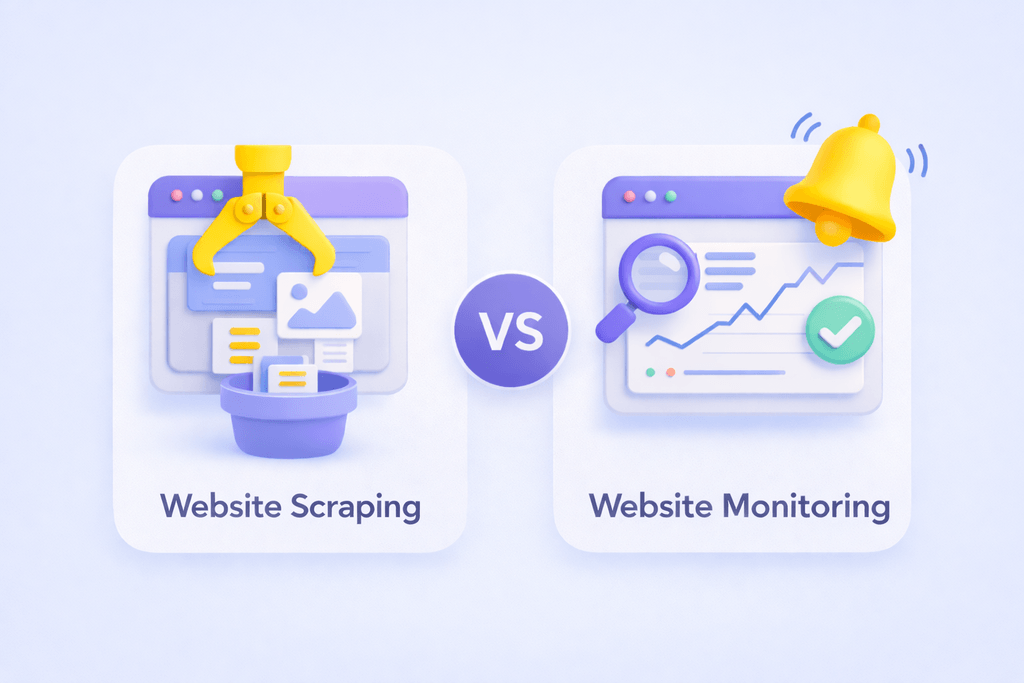
Web scraping is the process of extracting structured data from websites. Instead of just noticing that something changed, scraping pulls specific data points such as prices, product names, or listings.
For example, you might scrape:
- Product prices from an ecommerce site
- Job listings from a careers page
- Reviews from a marketplace
Scraping typically requires selectors like CSS or XPath, handling page structure changes, and managing data storage. It is powerful, but it can be fragile. If a website layout changes, your scraper may stop working.
What is website monitoring
Website monitoring focuses on detecting changes rather than extracting structured data. It alerts you when something on a page updates.
Instead of collecting raw data, monitoring answers:
- Has this page changed
- What changed
- When did it change
Tools like monity.ai notify you automatically when updates happen, often highlighting the exact differences.
Key differences between web scraping and monitoring
Purpose
Web scraping is about collecting data at scale. Website monitoring is about detecting and understanding changes.
If you need a dataset, scraping is useful. If you need alerts and insights, monitoring is the better fit.
Complexity
Scraping usually requires technical setup such as writing scripts, maintaining selectors, and handling errors.
Monitoring is much simpler. You choose a page, set conditions, and receive alerts. This makes monitoring more accessible for non-technical teams.
Maintenance
Scraping breaks easily when page structure changes, elements move, or anti-bot measures are introduced.
Monitoring tools are more resilient because they track visual or structural changes without relying heavily on fixed selectors.
Use cases
Scraping is better for collecting large datasets, feeding dashboards, and building internal data pipelines.
Monitoring is better for tracking competitor updates, detecting price changes, following product availability, and staying informed about website changes.
Speed and efficiency
Scraping often runs on schedules and processes large volumes of data.
Monitoring works in real time or near real time, notifying you only when something changes. This reduces noise and focuses on what matters.
Real examples to make it clear
Competitor pricing
If you scrape, you collect all prices daily and analyse them later. If you monitor, you get an alert the moment a competitor changes pricing.
Product availability
Scraping gives you a dataset of stock levels. Monitoring tells you instantly when a product goes back in stock.
Landing page updates
Scraping might miss context or layout changes. Monitoring shows exactly what changed visually or in content.
When to use web scraping
Use scraping when you need structured data at scale, want to build datasets for analysis, and are comfortable managing technical setups. It is ideal for data-heavy workflows.
When to use website monitoring
Use monitoring when you want real time alerts, care about changes rather than raw data, and prefer a simple setup.
This is where tools like monity.ai stand out, especially when combined with AI to summarise what actually changed.
Can you use both together
Yes, and many businesses do.
A common setup is to use monitoring to detect changes and scraping only when deeper data is needed. This reduces unnecessary data collection and keeps workflows efficient.
Common mistakes to avoid
- Building scrapers when alerts would be enough
- Collecting too much unused data
- Underestimating maintenance
FAQ
Is web scraping legal
It depends on the website and how the data is used. Always check terms of service and applicable laws.
Can website monitoring replace scraping
Not entirely. Monitoring is better for tracking changes, while scraping is better for collecting structured data.
Do I need coding skills for website monitoring
No. Most monitoring tools are designed for non-technical users.
Which is more accurate
Both are accurate in different ways. Scraping captures exact data, while monitoring captures meaningful changes.
Conclusion
Web scraping and website monitoring are often confused, but they serve different purposes.
Scraping is about collecting data. Monitoring is about understanding change.
For most business use cases, especially competitor tracking and real time alerts, monitoring is the faster and more practical solution. Scraping becomes useful when you need deeper datasets.
If your goal is to stay informed without manual effort, monitoring is usually the better place to start.